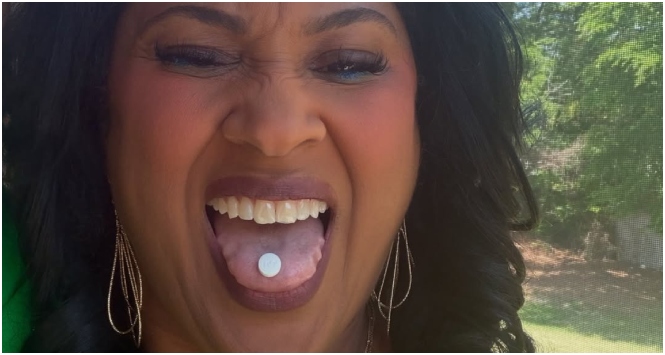
In honor of Mental Health Awareness Month this month of May, award-winning author Kennedy Ryan has done what she has always done best: told the truth. Only this time, the story she shared was her own.
Ryan, whose novels have become known for their emotional depth and honest portrayals of Black womanhood, posted a striking image of herself holding an antidepressant pill on her tongue.
In the accompanying caption, she reflected on being diagnosed with depression a few years ago, and how getting help changed everything.
“With the help of a great therapist (after 2 tries with wrong ones), and this little pill I now take every day, I got through one of the darkest seasons of my life,” she wrote.
The post, shared widely across social media including by the popular Instagram account @highfunctioningblackgirls, has sparked a crucial conversation about mental health, medication stigma, and the particular pressures Black women face to appear strong at all costs.
‘You Don’t Look Depressed’ – A Dangerous Phrase
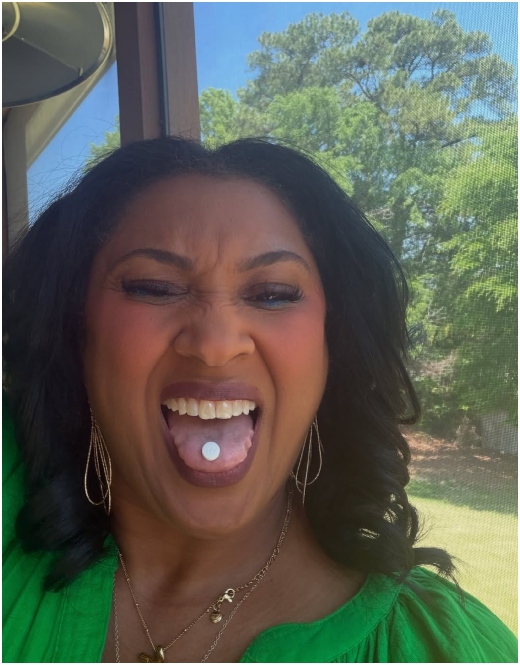
Ryan went on to share that many of the opportunities and doors she is now walking through existed on the other side of depression—but at the time, she “couldn’t see that” and “couldn’t FEEL it.”
For many Black women, that part landed hardest. And so did the unspoken cultural judgment that Ryan’s post directly challenged.
“You Don’t Look Depressed” is a phrase that has kept too many Black women suffering quietly, the @highfunctioningblackgirls account noted in a follow-up post featuring Ryan’s words.
The phrase dismisses lived experience, enforces a performance of wellness, and discourages honest conversations about mental health struggles.
Depression is often hidden beneath high achievement, caregiving, overworking, and the relentless pressure to keep functioning no matter how heavy life becomes.
In communities where strength is often expected, vulnerability can feel like failure. And medication? For many, it remains stigmatized, seen as a weakness or a shortcut rather than a legitimate medical treatment.
Ryan’s vulnerability directly challenged that silence.
A Novelist Who Writes Black Women With Tenderness—Now Offering That Grace to Herself
Across her bestselling love stories, including the acclaimed King series and Reel, Ryan has consistently written Black women grappling with grief, softness, survival, caregiving, and emotional healing. She has built a devoted readership precisely because she refuses to flatten Black female experience into stereotypes.
This time, Ryan offered that same tenderness and complexity to herself.
And for many women online, the image of a successful Black woman openly taking medication, not hiding the pill bottle, not whispering about therapy, became a permission slip.
Permission to stop pretending. Permission to ask for help. Permission to embrace honesty, self-love, and a life beyond mere survival.
The Search for the Right Therapist
One detail in Ryan’s post resonated deeply with readers who have navigated the mental health system: “after 2 tries with wrong ones.”
Finding a therapist who is both competent and culturally attuned to the specific experiences of Black women is a documented challenge.
Studies have shown that Black patients often fare better with therapists who understand the cultural context of race-based stress, microaggressions, and intergenerational trauma. But access to such care is not evenly distributed, and many give up after a poor fit.
Ryan’s admission that she kept trying and eventually found the right help offers a road map, not just a confession.
‘I Did and I’m So Glad’
“If you’re struggling or hurting,” Ryan wrote, “I highly recommend getting help. I did and I’m so glad.”
Those six words—”I did and I’m so glad”—carry the weight of testimony. They are not clinical advice. They are not a prescription for anyone else’s depression. But they are an invitation: to talk, to ask, to keep trying when the first therapist isn’t the right fit, and to accept that a “little pill” is not a weakness but sometimes, a lifeline.
Why This Conversation Matters
Mental Health Awareness Month, observed every May, aims to reduce stigma and encourage help-seeking. But for Black Americans—and Black women in particular—systemic barriers, cultural expectations, and mistrust of medical institutions have historically suppressed open dialogue.
According to the Health and Human Services Office of Minority Health, Black adults are more likely than white adults to report persistent symptoms of emotional distress but significantly less likely to receive treatment. When they do seek care, finding a culturally competent therapist can be a major hurdle.
Public figures like Ryan, who speak openly about their own journeys, help normalize the conversation. They make it harder for the phrase “You don’t look depressed” to shut down someone who is silently suffering.
The Bottom Line
Ryan’s post is not the end of the conversation, it is a beginning. A start to more honest discussions around dinner tables, in group chats, and between Black women who have been carrying too much for too long.
“This little pill saved my life,” she effectively said, without apology.
For thousands of women reading those words, the feeling was mutual.
If you or someone you know is struggling with mental health, please reach out to a mental health professional or contact your country’s crisis helpline.