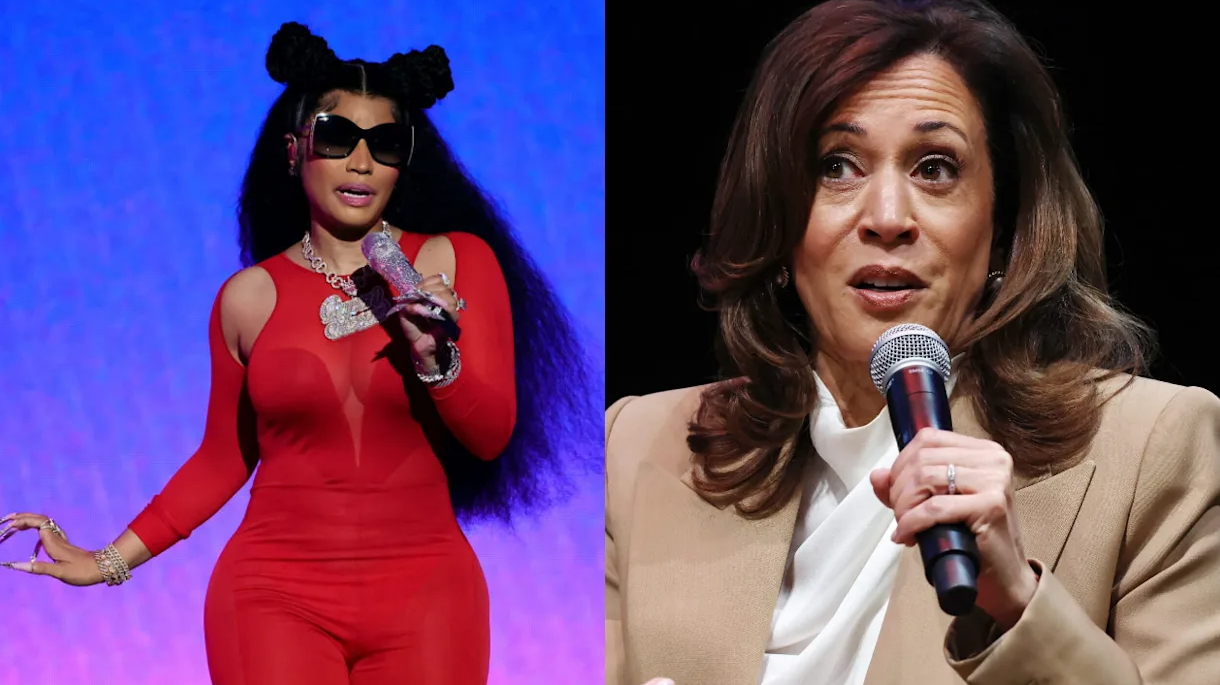
Kamala Harris is once again navigating the unpredictable terrain where politics collides with pop culture, finding herself at the center of a fast-moving online backlash fueled by one of music’s most devoted fanbases.
During a recent appearance on the “Now You Know with Knowa De Baraso” podcast, Harris spoke in broad terms about the dangers of misinformation in today’s political climate. Without directly targeting anyone, she acknowledged that false information can spread both intentionally and unintentionally, emphasizing the need for greater public awareness and accountability.
The conversation took a sharper turn when the topic shifted toward Nicki Minaj, whose recent political commentary has stirred controversy. Rather than criticizing Minaj outright, Harris used the moment to underscore a larger point about shared facts and understanding.
“One of the things about mis- and disinformation is, we have to, when we disagree with someone, take that into account,” Harris said. “We may just not be working with the same information… making sure we’re on the same page about the fact that two plus two will always equal four.”
That careful phrasing did little to soften the reaction. Minaj’s fiercely loyal fanbase, the Barbz, quickly mobilized across social media, interpreting Harris’s remarks as dismissive and condescending. Posts defending the rapper flooded timelines, with some users portraying Minaj as more authentic and Harris as out of touch.
The episode highlights the growing number of digital fan communities, which now operate less like casual audiences and more like rapid-response teams, ready to defend their icons at a moment’s notice. When celebrities intersect with political discourse, the fallout can be swift and deeply personal.
Minaj herself has drawn scrutiny in recent years for amplifying disputed claims and aligning with certain right-leaning narratives, blurring the line between entertainment and political influence. That evolution has made her a lightning rod in debates about misinformation and celebrity responsibility.
For Harris, however, the focus appears to remain on the bigger picture. She reiterated her commitment to promoting fact-based dialogue ahead of the 2026 midterm elections, while downplaying speculation about her own political future.
If this moment proves anything, it’s that today’s political arena isn’t confined to podiums and press briefings. It lives online, shaped by fandoms, influencers, and the volatile chemistry between them.