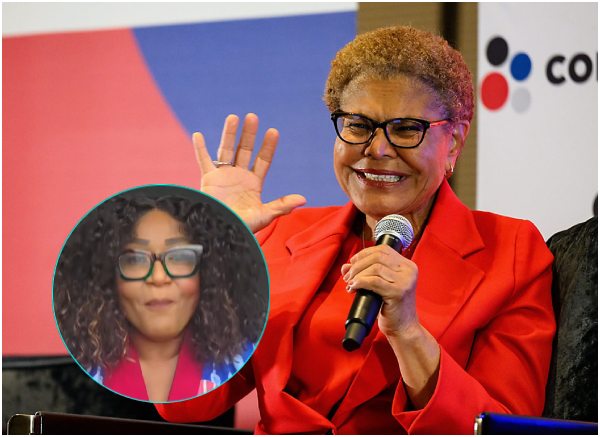
Political commentator and podcaster Nikki Free is arguing that the public discussion surrounding the political challenge between Los Angeles Mayor Karen Bass and reality television personality Spencer Pratt reflects a deeper double standard in American politics.
In a widely shared social media video, Free contended that Black women in public life are routinely expected to prove their qualifications through decades of experience, while white men often receive political credibility based on confidence, visibility, or public grievance alone.
“A black woman needs 40 years of receipts, a white man needs 40 minutes yelling on a podcast, and we are all supposed to believe that’s meritocracy, not white supremacy,” Free said.
Her remarks came as discussions continue about the future of leadership in Los Angeles and the broader national debate over who is considered qualified to hold public office.
Contrasting Backgrounds
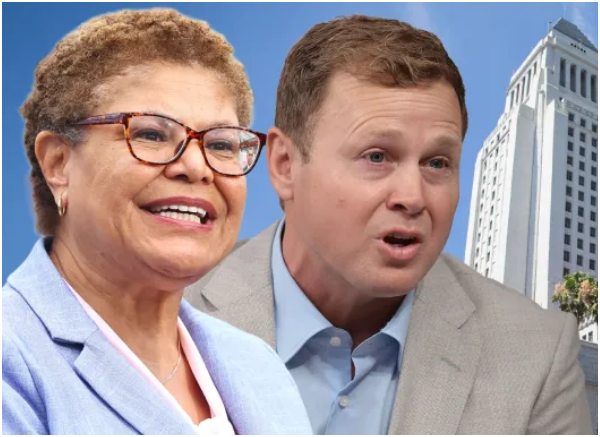
Free pointed out the stark differences between Bass and Pratt’s professional backgrounds.
“In 2026, an extremely qualified Black woman with 40 years of receipts still has to fight for her life against a white man with a grievance and a Wi-Fi connection,” she said.
Bass, a longtime public servant, has built a political career spanning decades. Before becoming mayor of Los Angeles, she served in the California State Assembly, including as Speaker of the Assembly, and later represented California in Congress. She has also been involved in community organizing and public policy initiatives throughout her career.
Pratt, by contrast, rose to prominence as a reality television personality through MTV’s The Hills and has remained a public figure through social media, podcasts, and entertainment ventures.
“Karen Bass has spent decades in public service, state assembly, Congress, community leadership, public policy, actual governing experience,” Free said. “The woman has spent her adult life doing the work.”
A Broader Critique of Political Culture
While Free used Bass and Pratt as examples, her commentary extended beyond the two individuals.
She argued that American politics has historically rewarded certain traits in white male candidates that would not be viewed the same way in women or people of color.
“But that’s because America has always had a weakness,” she said. “White male anger, white male grievance, and white male confidence. Again and again those things get treated as qualifications all by themselves.”
Free suggested that the phenomenon is not limited to local politics and pointed to national elections as evidence of what she sees as a recurring pattern.
She compared the discussion surrounding Bass and Pratt to broader political contests in which experienced Black women have faced intense scrutiny while less experienced male candidates have gained significant support.
Qualifications and Perceptions
At the center of Free’s critique is the idea that qualifications are not evaluated equally across demographic groups.
“Meanwhile, Black women are expected to arrive with a résumé so long it needs its own carrying case,” she said. “Degrees, experience, accomplishments, expertise, and receipts. Even then they’re still asked if they’re qualified.”
Her comments tap into longstanding discussions among political scientists and diversity advocates about how race and gender influence perceptions of leadership.
Research has frequently found that women, particularly Black women, often face higher standards of scrutiny when seeking leadership positions in politics, business, and other public-facing professions.
Supporters of Free’s argument say such disparities help explain why highly qualified women candidates are often required to defend credentials that would rarely be questioned in male counterparts.
Critics, however, argue that political success depends on a wide range of factors—including voter sentiment, communication skills, and public appeal—and caution against reducing electoral dynamics solely to race or gender.
Renewed Debate About Representation
Free’s comments arrive during a period of heightened discussion about representation, political power, and the barriers facing women and minorities in public office.
Her assertion that “qualifications are often required for Black women, but for white men, anger is treated as a credential” resonated with many followers who viewed the statement as a reflection of broader societal inequities.
The conversation also highlights ongoing questions about how voters evaluate leadership, experience, and public trustworthiness in an era increasingly shaped by social media personalities, celebrity culture, and unconventional political candidates.
Whether one agrees with Free’s assessment or not, her remarks have reignited debate about the standards applied to political candidates, and whether those standards are truly the same for everyone.
As discussions about leadership and representation continue across the country, Free’s central argument remains clear: experience and accomplishment, she believes, should matter more than visibility, outrage, or celebrity status when determining who is fit to govern.