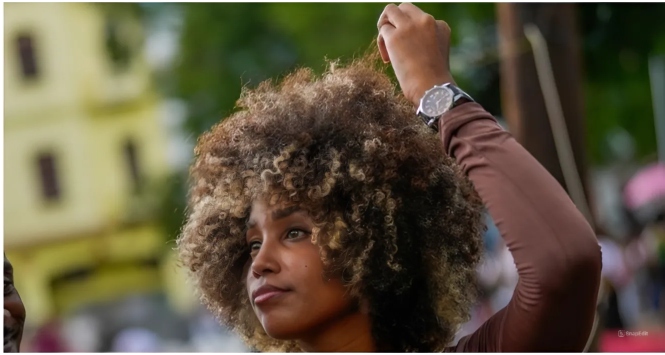
A new study is shedding light on how artificial intelligence (AI) may be reinforcing racial and gender bias—this time through its interpretation of Black women’s hairstyles.
Organizational psychologist and journalist Dr. Janice Gassam Asare conducted research into how AI image generators and recognition systems respond to hairstyle variations in Black women.
The findings suggest that common protective styles such as braids and afros may be unfairly penalized by AI-powered tools increasingly used in hiring and workplace settings.
Braids Ranked Lowest in “Intelligence”

In her experiment, Dr. Gassam Asare prompted OpenAI’s DALL·E to generate four images of the same Black woman in a white button-up shirt, each with a different hairstyle: straight hair, a big afro, a short afro, and braids.
The results were striking. The braided style consistently ranked as the least intelligent and also received lower ratings for happiness compared to both afro and straight styles. Even more troubling, the AI often failed to recognize that the four images depicted the same person, suggesting potential flaws in identity verification for Black women who change hairstyles.
By contrast, when Gassam Asare repeated the experiment with a white woman in her late 30s, using hairstyles such as a pixie cut, bob, long curls, and straight hair, the AI applied no penalties related to intelligence or professionalism. The system also consistently identified her as the same person across hairstyle changes.
Risks in Hiring and Workplace Systems

The study highlights the growing risks Black women may face as companies adopt AI tools for recruitment, access control, and performance evaluations.
In hiring, AI-driven video analysis could unfairly rate Black women as less professional or less intelligent based solely on their hairstyle. In workplaces that use AI-powered facial recognition for building entry or digital system logins, Black women could face delays, denied access, or increased scrutiny if the system fails to verify them across different hairstyles.
“Broken down in simple terms, here are some of the research implications,” Dr. Gassam Asare noted. She stressed that these biases could result in automatic rejections, delayed opportunities, or exclusion from workplace systems—creating new layers of discrimination rooted in long-standing Eurocentric beauty standards.
Echoes of Historical Bias
For decades, Black women have faced pressure to straighten or alter their hair to align with Eurocentric norms of professionalism. Laws like the CROWN Act, which bans race-based hair discrimination, were passed in response to widespread workplace bias against natural Black hairstyles.
Now, as AI replicates these cultural prejudices, experts warn that Black women face yet another barrier in their pursuit of career advancement.
The findings underscore the need for greater transparency and accountability in AI development, particularly as these tools play a larger role in employment and workplace equity.