
Content creator Adaku Mbagwu has shared an emotional reflection about ending a promising relationship due to unresolved trauma.
She said an emotional defense mechanism made her realize she was not ready for the kind of partnership she desired.
In a candid Instagram video, Mbagwu explained that after being single for a long time and intentionally envisioning the type of partner she wanted, she believed she had finally found him earlier this year.
“He ticked all the boxes I was looking for,” she said. “I felt like I manifested him.”
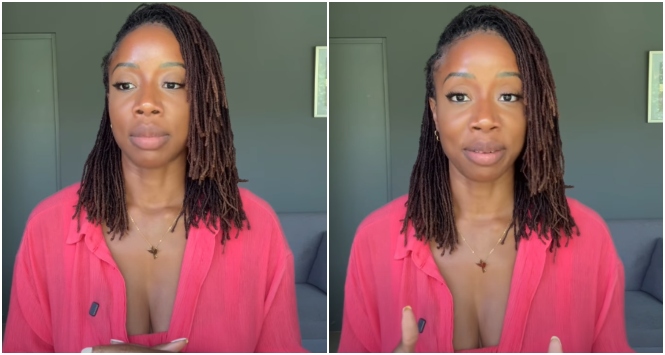
But after the couple’s first serious disagreement just weeks into the relationship, she said deeper emotional wounds surfaced in ways she could no longer ignore.
“I just walked away from someone I want to be in a relationship with because I’ve had to accept that I’m not relationship material,” Mbagwu said in the video. “At first I was blaming him for not feeling safe, but no matter what he gives to me, there’s a lack of safety within me that I have to resolve.”
Her remarks quickly resonated with viewers online, particularly women discussing emotional burnout, hyper-independence, attachment trauma, and the pressures placed on eldest daughters within families.
“So brave and emotionally mature to recognize and share. That’s growth right there and more than half the battle,” someone shared.
A Conversation About Survival Mode and Emotional Guardedness
Mbagwu framed her experience as part of a broader emotional pattern she believes affects many “firstborn daughters” who grew up feeling responsible for others while rarely feeling emotionally supported themselves.
“One of the traumatic patterns that comes from being a firstborn daughter is feeling like no one really shows up for you,” she explained. “So my default is not to trust.”
She described developing what she called an “inner man” — a hardened protective persona she created to survive emotionally difficult experiences and ensure she could depend on herself.
“I needed to make sure that I was good,” she said. “So I created this strong persona, which can come across as argumentative, can come across as aggressive.”
According to Mbagwu, those defense mechanisms eventually made conflict within the relationship feel emotionally unsafe, even when both partners were attempting to communicate and grow together.
“What I’m contending with is this feeling that I need to stick up for myself,” she said. “The way that it comes across is aggressive.”
Mental Health Experts Increasingly Discuss Hyper-Independence
While Mbagwu’s comments are deeply personal, the themes she raised mirror broader conversations taking place online and in mental health spaces about trauma responses in relationships.
Psychologists and relationship therapists have increasingly discussed how chronic disappointment, emotional neglect, or parentification in childhood can contribute to hyper-vigilance, difficulty receiving care, and struggles with vulnerability in adulthood.
Mbagwu acknowledged that much of her behavior stemmed from survival instincts rather than intentional hostility.
“I need to resolve that and find a way to manage that and say, like, the world is not so bad and you can trust some people,” she said.
Rather than framing the breakup as a failure, she presented it as an act of self-awareness and accountability.
“I’m committed to transforming it,” she told followers. “I just wanted to share this to let anyone who’s struggling with the same thing know you’re not alone.”
Her vulnerability has prompted thousands of reactions online, with many users praising her willingness to discuss emotional healing openly instead of solely blaming a partner after a breakup.
Others said her comments highlighted how relationship struggles are often connected to unresolved emotional survival patterns rather than simple incompatibility.

