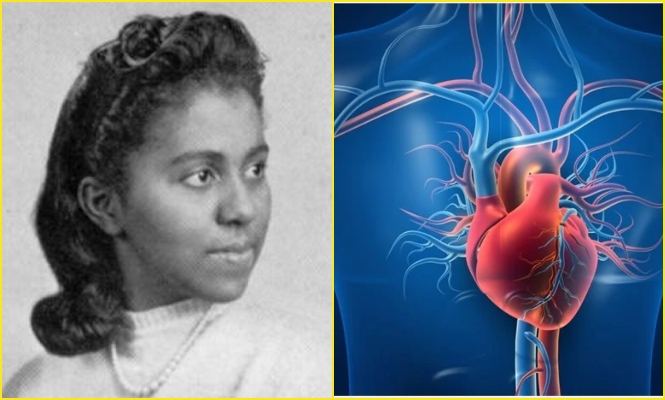
In 1947, a determined young woman named Marie Maynard Daly walked into Columbia University and made history.
Within three short years, she became the first Black woman in the United States to earn a Ph.D. in chemistry, a feat that shattered barriers and redefined what was possible for women and people of color in science.
But Daly’s greatest legacy wasn’t just her title; it was her science.
At the Rockefeller Institute for Medical Research, Daly’s pioneering studies revealed how proteins are synthesized from RNA, a breakthrough so foundational that James Watson later cited her work in his Nobel Prize lecture on the structure of DNA.

Long before the world understood genetics as we do now, Daly was already identifying the building blocks of life itself.
Her brilliance didn’t stop at biochemistry. Daly turned her attention to a question that continues to haunt millions: why do hearts fail? Through groundbreaking experiments, she became the first scientist to prove the link between high cholesterol, high sugar intake, and artery blockage, as well as how hypertension accelerates heart disease.
Every modern cardiovascular treatment, from statins to heart-healthy diet guidelines, traces back to Daly’s trailblazing discoveries.
Despite her monumental contributions, Daly’s name has too often been reduced to a footnote in scientific history, remembered primarily as “the first Black woman Ph.D” rather than the architect of modern biochemistry, genomics, and cardiovascular medicine.
Her story is one of brilliance, perseverance, and transformation.
At a time when systemic barriers tried to define what she could not do, Daly defined what science could become.
Her story proves that representation in science isn’t just about inclusion—it’s about innovation. Because when a voice like Marie Maynard Daly’s breaks through, the entire world changes.