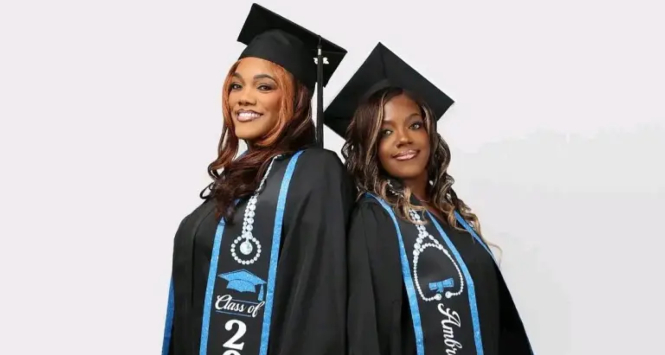
After years of battling a rare kidney disease that nearly claimed her life, Ambrealle Brown and her mother, Nija Butler, are now living proof that love and resilience can defy the odds.
The Louisiana mother-daughter duo recently walked across the graduation stage together, both earning their nursing degrees, just two years after Butler donated a kidney to save her daughter’s life.
For Brown, 34, the road to that moment was paved with hardship, heartbreak, and ultimately, hope.
In 2016, while working on prerequisites for nursing school, Brown was diagnosed with Focal Segmental Glomerulosclerosis (FSGS), a rare and potentially fatal kidney condition. Her life quickly began to revolve around grueling dialysis treatments lasting up to 13 hours a day. The dream of becoming a nurse was put on indefinite hold.
“She wanted to give up,” Butler, 48, recalled. “She was tired of just being connected to a tube.”

Then came the turning point. Although doctors had once ruled her out as a viable donor, Butler quietly underwent testing and discovered she was, in fact, a match. In March 2023, she gave her daughter the ultimate gift—a kidney.
“I didn’t even tell her I was getting tested,” Butler said. “I didn’t want to get her hopes up. But when she called to tell me she was getting a transplant, I already knew. I said, ‘It’s me.’”
The transplant, performed by doctors at Tulane University School of Medicine, was Louisiana’s first robotic-assisted kidney transplant—a minimally invasive procedure designed to reduce pain and recovery time. The success of the operation gave Brown her life back. And for the first time in years, she could focus on her dream again.
So could her mother.

For 16 months, the two studied side-by-side at the Baton Rouge General School of Nursing. In April, they graduated together, proudly wearing white caps and gowns—a symbolic and emotional full-circle moment.
“I couldn’t have done it without her,” Brown said. “I’m happy I was able to go through that milestone with her, side by side.”
Brown has since accepted a position in a burns intensive care unit, while Butler continues her work at a psychiatric facility.
The pair now hopes to use their platform to advocate for kidney disease awareness, the importance of organ donation, and the power of not giving up.
“Thank you for giving me life twice,” Brown told her mother during an interview with the Associated Press. “Most people don’t get do-overs.”
Butler wiped away a tear and responded, “And I would do it again.”