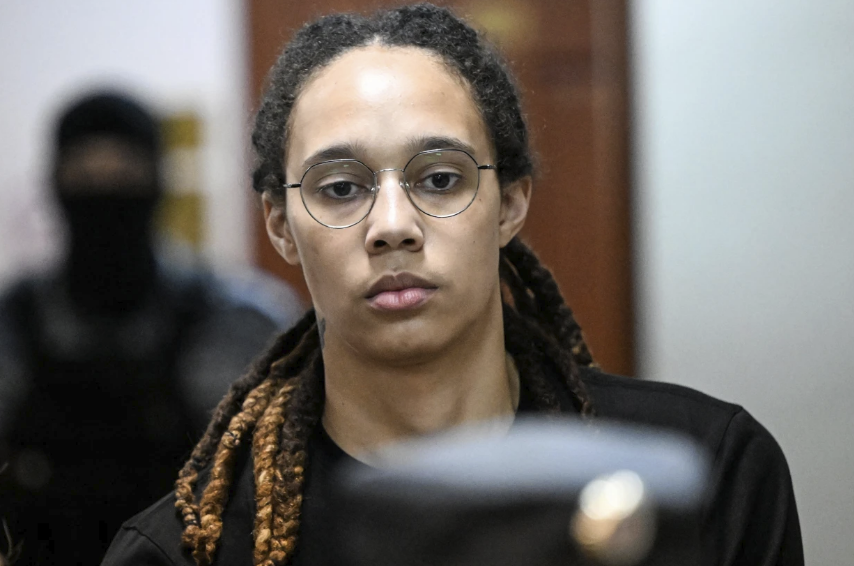
WNBA star Brittney Griner has long been candid about her harrowing detention in Russia, but a new revelation shared on Cam Newton’s podcast this week is sending shockwaves across the sports and human rights communities.
Griner, now in her 13th professional season, described a deeply disturbing moment just before her 2022 release in a U.S.-Russia prisoner exchange.
In the emotional interview, Griner recounted a dehumanizing strip search conducted during her transfer from a penal colony to a Moscow men’s prison—an act she believes was intentionally designed to humiliate and psychologically torment her.
“They had me stripped down, butt naked, in front of a room like probably 7 to 8 men,” Griner said. “They had the Polaroid and had me spinning in a circle… taking photos of my tattoos. That was their last little addict to mess with me.”
Griner had previously been held at IK-2, a notorious penal colony known for its forced labor, subzero conditions, and limited access to basic hygiene and communication. But this latest account reveals an even darker chapter in her detention—one not about legal protocol, but raw power and control.
She believes her transfer to the men’s prison was never meant to serve any logistical purpose but rather to rattle her spirit and remind her of the power the Russian state held over her. She described being made to feel like an object, reduced to a display meant to strip her of dignity just before her release.
The prisoner swap, which took months to negotiate, eventually culminated in Griner being flown from Moscow to Abu Dhabi, where she was exchanged for convicted Russian arms dealer Viktor Bout in a high-profile deal brokered by the Biden administration.
But even as her freedom neared, Griner said the mistreatment continued. She recalled being picked up by masked Russian operatives, driven to a secret airfield that “doesn’t appear on maps,” and taunted during the flight for her identity and sexuality.
Griner’s story is not just about wrongful detention; it is about resilience, survival, and the psychological warfare used against high-profile detainees. Her courage in speaking out underscores the emotional and mental toll such experiences take—even after the spotlight has faded.
As Griner continues to use her platform to shed light on her ordeal, she reminds the world that her return to basketball wasn’t just about sport—it was about reclaiming her humanity.