
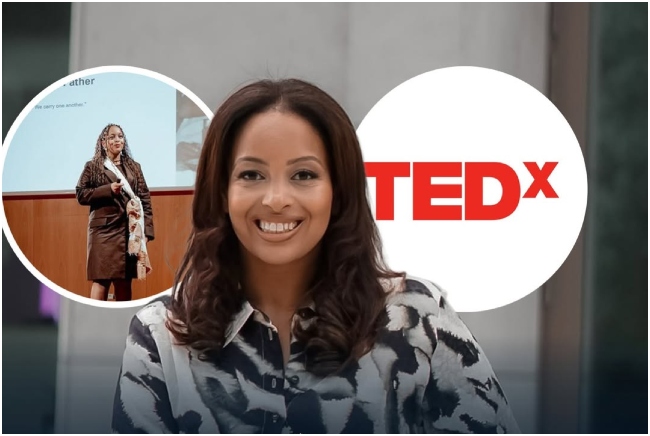
Eritrean tech professional Yehdega has delivered a compelling TEDx Talk urging the global technology community to rethink how artificial intelligence is designed by incorporating African philosophy into the development of emerging technologies.
Speaking at TEDxKarlsruhe in Germany, Yehdega explored the ethical and cultural foundations of AI, arguing that current systems are largely shaped by Western individualistic worldviews that prioritize competition, efficiency, and growth—often at the expense of equity, balance, and community.
“AI is not neutral,” she told the audience. “Every system carries a philosophy, and right now the philosophy it carries is only one worldview—Western individualism.
Bridging Technology, Ethics, and Culture
Yehdega works in the tech industry as a Software Release Manager and is academically trained as a political scientist. Her professional journey spans Silicon Valley and Europe, and she currently works in Germany, where her career operates at the intersection of technology, ethics, and culture.
In her talk, she explained that her perspective is shaped equally by her technical experience in AI-driven environments and her upbringing as an Eritrean, where values of community, moral responsibility, and relational thinking are deeply embedded.
According to Yehdega, these African philosophical traditions offer essential insights that are largely missing from today’s AI ecosystems.
Challenging a One-Worldview AI Future
Yehdega warned that encoding a single philosophical framework into intelligent systems risks amplifying inequality and injustice on a global scale.
“It’s competition over cooperation. It’s efficiency over equity. It’s growth over balance,” she said. “If you code that worldview into machines, you don’t just create new problems—you amplify injustice.”
She argued that African philosophies—often grounded in collective well-being, moral accountability, and interconnectedness—provide a more human-centered approach to technological progress. Rather than viewing them as abstract cultural ideas, Yehdega positioned these philosophies as practical roadmaps for building ethical and inclusive AI systems.
A Call for Inclusion in Global AI Development
Central to Yehdega’s message is the concern that African voices remain largely excluded from shaping the future of artificial intelligence, despite the continent’s rich intellectual traditions and growing role in global technology adoption.
“The question is not whether philosophy impacts AI,” she said. “The question is which philosophy will shape the machines that will shape us?”
Her talk has resonated widely among audiences interested in AI ethics, decolonizing technology, and the role of non-Western knowledge systems in shaping the digital future.
As debates around artificial intelligence governance intensify worldwide, Yehdega’s TEDx Talk adds to a growing call for more inclusive, culturally diverse frameworks—one that recognizes African philosophy as a vital contributor to a more balanced and humane technological future.