A Minneapolis woman who was forcibly removed from her vehicle by Immigration and Customs Enforcement (ICE) agents has spoken publicly for the first time.
Aliya Rahman is offering an emotional and detailed account of what she says was a traumatic, confusing, and dehumanizing encounter with federal officers.
Rahman, who is disabled and autistic, told CNN in an exclusive interview that she was not participating in a protest when she was dragged from her car. Instead, she said she was simply trying to reach a doctor’s appointment when she became caught in traffic near a demonstration against President Donald Trump’s immigration crackdown.
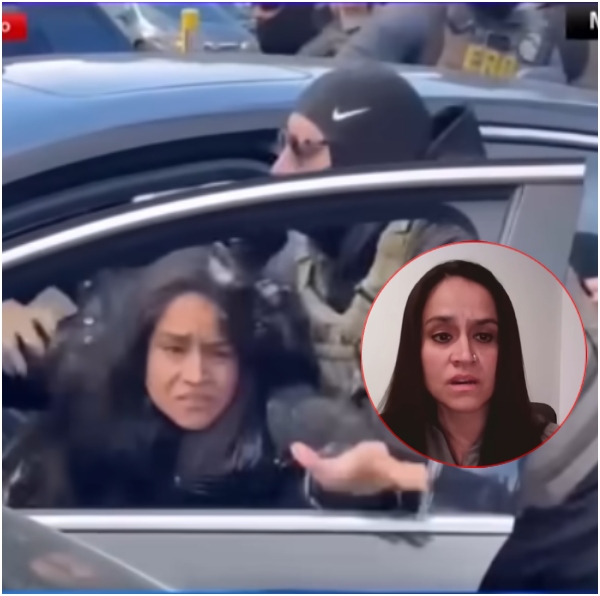
Video of the incident, which quickly went viral, shows agents pulling Rahman from her vehicle as she screams that she is disabled. The arrest occurred just two blocks from the site where an ICE agent had shot and killed Rene Good one week earlier, intensifying public scrutiny of federal enforcement actions in the area.
The Department of Homeland Security later described Rahman as an “agitator,” claiming she ignored repeated commands to move her vehicle and was arrested for obstruction. Rahman strongly disputes that account.
“I was driving slowly through what felt like a militarized traffic jam,” Rahman said. “There were vehicles blocking the road, people everywhere, and a cacophony of conflicting commands. I was confused and trying to understand what I was supposed to do.”
Rahman explained that her autism includes auditory processing challenges, making it difficult to distinguish instructions when multiple voices are shouting. She said officers issued threats alongside commands, including warnings that they would break her car window, which she described as terrifying rather than instructive.
“It wasn’t a warning. It was a threat of violence,” she said. “That shouldn’t be packaged with an instruction.”
Minneapolis Police Chief Brian O’Hara publicly criticized the video after reviewing it, saying he was disturbed by the treatment shown.
“It pisses me off to see men doing that to a woman who’s disabled,” O’Hara said, adding that if the officers involved worked for him, “they’d have a problem right now.”
After being removed from her car, Rahman said her treatment worsened while in custody. She described what she called “six stages of dehumanization” during detention and processing, claiming she repeatedly requested medical help and disability accommodations that were ignored.
Rahman said officers failed to bring her cane from the car, refused to provide a wheelchair for an extended period, and mocked her mobility needs. At one point, she said she lost consciousness and was later taken away in an ambulance.
“There was no medical screening. I was never asked for my ID,” she said. “I was told I was under arrest, but I was never charged.”
Her attorney, Alexia Van Brunt, said any potential charges would be “completely baseless,” arguing that officers violated established standards for interacting with both civilians and people with disabilities.
“Once they knew she had a disability, the force escalated,” Van Brunt said. “That violates every policing standard and every standard for disability accommodation.”
Rahman explained that her experience should not be dismissed as an isolated incident or a misunderstanding. She warned that such treatment reflects broader systemic issues within immigration enforcement.
“These practices don’t make anyone safer,” she said. “They harm people, and they erode trust.”
As calls grow for greater accountability and oversight of ICE operations, Rahman’s testimony adds a deeply personal dimension to the national debate over immigration enforcement, disability rights, and the use of force by federal agents.