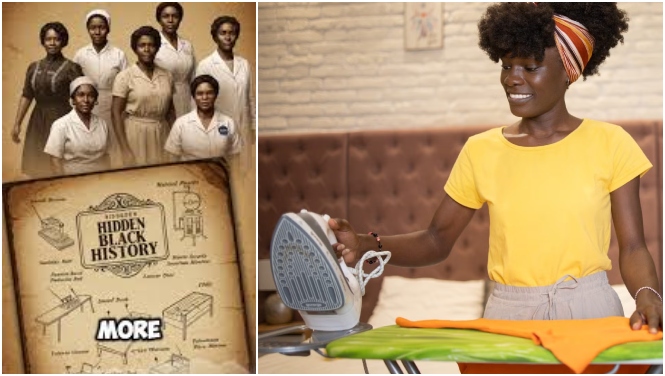
Think about pressing your shirt sleeve just right, sending a 3D image across space, or installing a home security camera—chances are, innovations behind those everyday technologies trace back to Black women whose stories are often erased.
A viral social media spotlight recently recalled inventions from visionaries like Sarah Boone and Valerie Thomas—women whose breakthroughs continue to shape our world.
The Forgotten Innovators

These are two of the seven Black women inventors whose contributions deserve full recognition:
- Sarah Boone (c. 1832-1904), born into slavery in North Carolina, taught herself to read later in life. In 1892, she patented improvements to the ironing board (U.S. Patent No. 473,653) that made pressing sleeves and fitted garments easier thanks to a narrow, curved design that accommodated seams and shapes.
- Valerie Thomas (born 1943) of NASA developed the illusion transmitter, patented in 1980, which uses concave mirrors to project 3D illusions. This invention foreshadowed modern holographics and 3D imaging technology used in movies, satellite imaging, and potentially surgical imaging technology.
The social clip also mentions other pioneers: Patricia Bath (laser cataract surgery), Marie Van Britain Brown (home security systems), Marjorie Joyner (permanent wave machine), Mary Kenner (early sanitary belt), and Sarah Good (folding bed). Many of their stories are harder to trace in documents, but they form part of the broader pattern: Black women innovating, often without due credit.
Why These Histories Were Hidden—and Why It Matters Now
These stories were suppressed, marginalized, or forgotten for many reasons: systemic racism, lack of resources for patenting, and corporate or societal barriers that discouraged Black women from being associated with inventions. Mary Kenner, for example, reportedly had her inventions rejected once her race was discovered. Others invented in eras or fields where documentation was scant.
But these inventions are not just relics; they shaped modern technology:
- The ironing board design enabled better garment care and comfort.
- The illusion transmitter paved the way for what we see in 3D displays and helped push satellite imaging and remote sensing forward.
Recognizing these inventors is not just about credit—it helps reshape how we tell the history of science and technology, broadens representation in STEM fields, and helps children of all backgrounds see themselves as potential inventors.
Verifying the Facts: What Records Confirm
- Patent documents: Sarah Boone’s patent for her ironing board improvement is public record (US 473,653).
- NASA & Lemelson Institute: Verified information about Valerie Thomas’s work, her role in the Landsat program, her illusion transmitter patent, and her ongoing influence in STEM.
What Still Needs Correcting
- Many of these inventions are under-celebrated in mainstream histories and in STEM curricula.
- Patenting records, when they exist, are often not widely known or taught.
- Corporate and educational recognition lags behind the “viral history” format: acknowledgement, memorialization, and accurate attribution still need work.
Tell Their Stories
These seven Black women—Sarah Boone, Valerie Thomas, Patricia Bath, Mary Kenner, Marie Van Britain Brown, Marjorie Joyner, and Sarah Good—did more than invent products; they shaped futures.
From pressing sleeves to curing blindness, from 3D imaging to security systems, their designs live on. It’s time their stories did too.