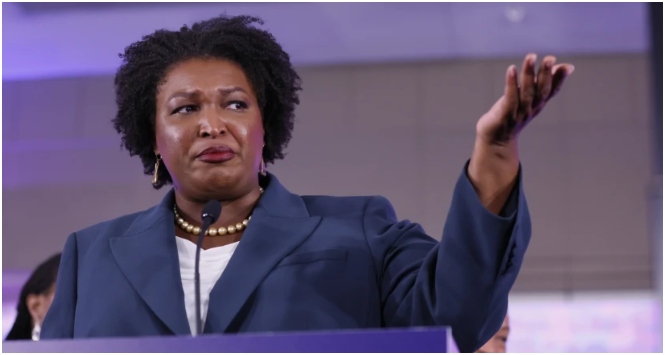
Former Georgia gubernatorial candidate Stacey Abrams has issued a sharp warning to her party.
The prominent Democratic strategist is arguing that Democrats risk losing public trust if they blur their core values in pursuit of so-called political centrism.
Abrams’ comments were shared in a video posted by Crooked Media on Instagram, accompanied by the caption: “The Democratic Party needs to define and live its values if it wants to bring people back into the tent.”
The remarks come amid renewed debate about the party’s direction following closely contested national elections and widespread voter disengagement.
Questioning ‘Centrism’ Without Values
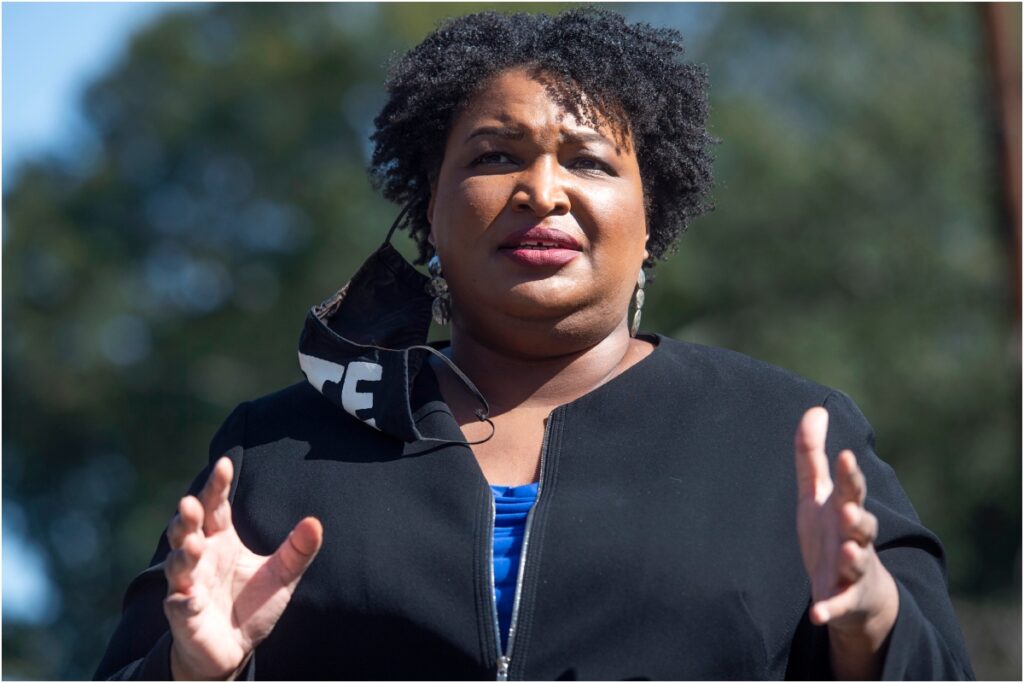
In the video, Abrams challenged what she described as a hollow interpretation of centrism, particularly when it comes to issues of race and identity.
“I don’t know what the centrist position on racism is,” she said, adding that while some voters hold genuinely moderate policy views, the term centrism is increasingly being used to excuse behaviour that conflicts with the party’s stated principles.
Abrams argued that attempts to strip identity and values from political messaging undermine trust, especially among voters who have historically felt excluded from the political process.
The Numbers Behind Disengagement
Pointing to recent voting patterns, Abrams highlighted what she sees as a deeper problem than partisan competition.
She cited figures showing 77 million voters backing Donald Trump, 75 million supporting Kamala Harris, and an even larger group—about 90 million eligible voters—choosing not to participate at all.
According to Abrams, that disengaged bloc represents people who do not see themselves reflected in either major party.
“My political advice,” she said, “is instead of trying to go after Buddhists to convince them to become Baptist—which is what you do when you go after a Republican voter—you just get Baptists to go to church.”
Rebuilding the Democratic Coalition
Abrams’ central argument is that Democrats should focus less on converting opposition voters and more on mobilising those who already broadly share the party’s values but feel alienated or unwelcome.
“We’ve got a lot of people who share our values, but do not feel invited into our party,” she said. While acknowledging internal differences, she stressed that there is enough common ground for Democrats to rally around clear priorities.
She said she is open to centrism if it means finding shared values—but not if it becomes a justification for abandoning principles in exchange for votes.
A Warning About Political Trust
Abrams concluded with a cautionary note, arguing that voters are being asked to place faith in a party that cannot clearly articulate what it stands for.
“If Democrats can’t say what we believe,” she said, “then we’re asking people to invest their hope and their time in something amorphous that may turn on them.”
For communities that have yet to see democracy consistently deliver tangible benefits, Abrams warned, that uncertainty represents a risky and potentially alienating proposition.
Her remarks land at a moment of intense introspection within the Democratic Party, as leaders and strategists grapple with how to rebuild trust, energise the base, and define a coherent identity ahead of future elections.