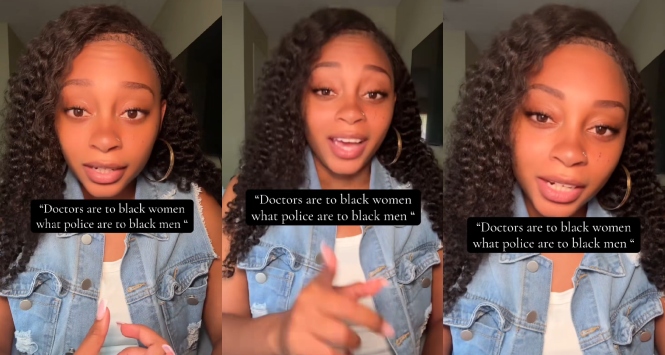
A young woman has sparked debate online after drawing an interesting parallel between police brutality against Black men and systemic bias in healthcare against Black women.
Her statement — “Doctors are to Black women what police are to Black men” — argues that there is medical racism at hospitals and that is evidenced by the disproportionately high maternal mortality rates among Black women in the United States.
In the video, the speaker, Modestly Fly, highlights the alarming similarities:
“A Black man can walk into a traffic stop and never walk out. Likewise, a Black woman can walk into a hospital and never walk out either.”
She goes on to argue that while Black men must survive a system that was never designed to protect them, Black women must survive a system that was never designed to believe them.
“They’ll [Black men] tell the police, I can’t breathe. They’ll [Black women] tell the doctor, I’m in pain. And in both cases, they get dismissed. Serena Williams almost died giving birth because the doctors didn’t take her seriously. She is one of the most famous women in the world. If she couldn’t get the proper care, just imagine the women who don’t have the fame, who don’t have the money, who don’t have the ability to fight back,” she said.
The comparison points to longstanding disparities in healthcare. Data from the Centers for Disease Control and Prevention show that Black women are three times more likely to die from pregnancy-related causes than white women, with many cases linked to providers dismissing their pain or failing to take symptoms seriously.
The viral clip also raises concerns about implicit bias in medicine. Scholars and advocates note that medical schools have historically perpetuated myths — such as the false belief that Black patients feel less pain — which continue to influence patient care. Critics argue this mindset can be just as deadly as police profiling.
Systemic racism in medicine has implications beyond healthcare. Failures in treatment, they argue, may intersect with civil rights protections, medical malpractice liability, and broader issues of access to equal protection under the law.
The growing online discussion reflects frustration with both institutions — law enforcement and healthcare — and calls for accountability, cultural competency training, and reforms that ensure Black lives are valued equally, whether on the street or in the hospital.