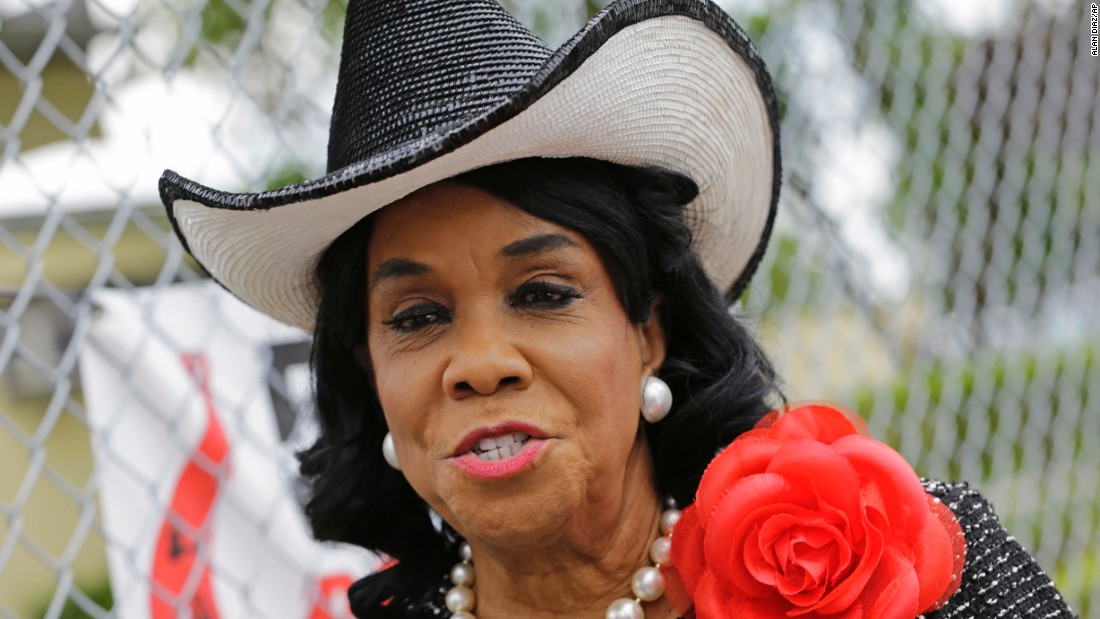
Congresswoman Frederica S. Wilson has condemned the Supreme Court’s 6-3 ruling in Louisiana v. Callais, calling the decision “a setback for voting rights and fair representation” after the court struck down Louisiana’s congressional map containing a second majority-Black district.
In a statement released following the ruling, Wilson said the decision weakens protections established under the Voting Rights Act of 1965 and threatens the political representation of Black voters and other minority communities.
“Let me be clear,” Wilson said. “For generations, people fought, marched, and even died for the right to vote in this country. The Voting Rights Act of 1965 was supposed to protect that right and make sure communities that were shut out of power finally had a fair chance to be heard.”
Wilson argued that while Section 2 of the Voting Rights Act technically remains in place, the court’s decision limits how effectively it can be used to challenge congressional maps that dilute minority voting power.
“In Louisiana, a map that created a second majority-Black district has now been struck down,” she said. “That is not just a legal change on paper. That is about representation. That is about whether communities finally get a seat at the table or are pushed back out again.”
The ruling has intensified debate in Louisiana, where lawmakers are now considering four new congressional maps ahead of a June deadline. Three of the proposed maps contain fewer majority-minority districts than the map invalidated by the Supreme Court.
One proposal, introduced by state Sen. Ed Price of Gonzales, would preserve two majority-minority districts. The remaining three maps, introduced by West Monroe state Sen. Jay Morris, would significantly reduce minority representation. Two include only one majority-minority district, while another contains none.
Residents and voting rights advocates voiced concern that the proposals could weaken Black voting power across the state.
“I feel like this is going to move us backward,” one Louisiana resident said.
Critics also challenged the fairness of the proposed districts, arguing that each map reduces Black voting influence. Morris denied accusations of racial gerrymandering, saying he “didn’t try to gerrymander for the purpose of race.”
State Sen. Sam Jenkins said lawmakers are expected to finalize a new congressional map by June.