When CBS News correspondent Jericka Duncan sat down with filmmaker Contessa Gayles to discuss her new Netflix documentary Songs From the Hole, the conversation cut straight to the heart of why the project matters.
“There was so, so much that I saw as far as potential to help people heal with this story,” Gayles explained in their interview. “The story itself really provides this real-life example of ways that we can respond to violence and harm without introducing more violence and more harm into the equation, and to respond in ways that are healing, that are restorative, that have accountability at the center, but are not revolving around punishment.”
A Story That Goes Beyond the Headline
Duncan herself admitted she was deeply moved by the documentary, praising its storytelling craft:
“I love how this film goes beyond the headline of a young man who committed a horrible crime — murder. It explores the events leading up to the crime and what happened after the fact.”
The “young man” at the center of Gayles’s hybrid documentary-musical is James Jacobs, who, at just 15, killed a teenager in Bellflower, California.
Three days later, his own brother, Victor, was murdered. Ten years into his life sentence, Jacobs found himself in solitary confinement — “the hole” — where he began writing music as a way to reckon with his past and reach for redemption.
Music as a Portal
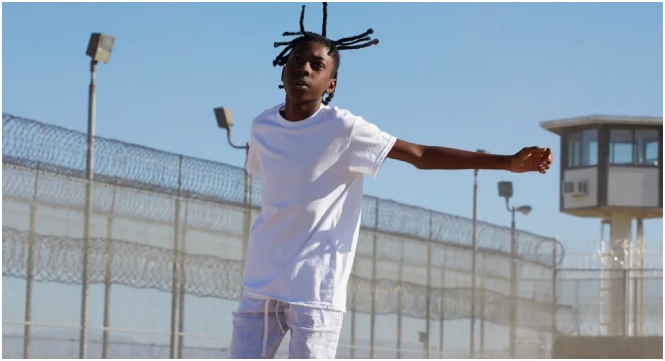
The New York Times review called the film “visually fluid and emotionally complex,” noting how Jacobs — known in music as JJ’88 — transformed solitude into a creative portal. His songs, including Letter to the Homies, Most Hunted, and the haunting Steel Grave, anchor the film.
One of the most powerful moments comes when Jacobs raps verses of Steel Grave to his father through a glass partition. His father listens, then tells him what’s missing: hope. As the Times critic observed, “Corny? Hardly. Gayles has crafted a film that refuses to tidy the conflicted feelings its subjects share — or those feelings it stirs in us.”
A Family’s Conflicted Grief
The documentary doesn’t shy away from the contradictions within Jacobs’s own family. His father, a preacher, recalls the torment of reading the police report of his son’s crime.
His mother, reflecting on the sentencing of her other son’s killer, confessed: “I was not satisfied.” That raw emotional conflict underlines the film’s central tension — how do communities reckon with violence without perpetuating cycles of punishment and despair?
A Six-Year Journey to the Screen
Gayles dedicated six years to bringing Songs From the Hole to life, weaving together interviews, stylized recreations, and musical performances.
Myles Lassiter shines as young James in dramatized segments that blur the line between documentary and visual album.
For Gayles, the labor was never just about cinematic artistry. It was about broadening the public imagination on justice and healing: “This story is about accountability, yes — but accountability that doesn’t strip people of their humanity.”
A Film That Stays With You

With a runtime of 1 hour and 37 minutes, Songs From the Hole refuses to offer simple conclusions. Instead, it poses “bedeviling questions about crime, punishment, and forgiveness,” as the New York Times wrote.
It’s a film that resonates long after the credits roll, not only because of the music that pulses through it but because of its willingness to let contradictions coexist.
Duncan perhaps summed it up best after the screening: “It was so wonderfully made… I was so touched by it.”
Songs From the Hole is now streaming on Netflix.