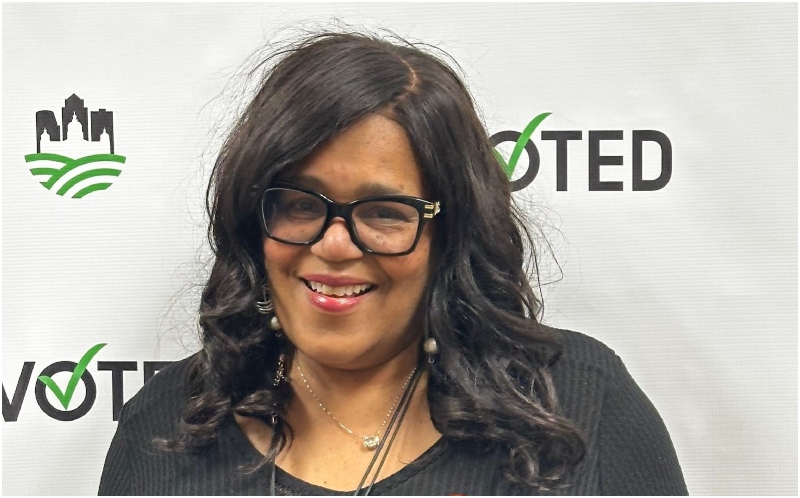
Democrat Renee Hardman has won a closely watched special election to the Iowa State Senate, becoming the first Black woman ever elected to the chamber and denying Republicans a two-thirds supermajority.
Hardman defeated Republican candidate Lucas Loftin by a decisive margin on Tuesday in a holiday-week election to fill a vacant seat representing parts of Des Moines’ suburban communities. The seat became open following the death of Democratic State Senator Claire Celsi on Oct. 6.

Hardman for Iowa/AP/File
Hardman, who currently serves as chief executive officer of nonprofit Lutheran Services of Iowa and is a member of the West Des Moines City Council, enters the Senate at a pivotal moment in Iowa politics. While women have previously served in the Iowa Senate, her victory marks a historic first for Black representation in the chamber.
The district leans Democratic, with registered Democratic voters outnumbering Republicans by roughly 3,300—about 37% to 30%—a factor that contributed to Hardman’s strong showing at the polls.
Her win carries significant implications for control of the Iowa Senate. Republicans had been seeking to reclaim a two-thirds supermajority, which would have given them expanded authority, including the ability to confirm appointments by Republican Governor Kim Reynolds without any Democratic support. That effort was blocked by Hardman’s victory.
Heather Williams, president of the Democratic Legislative Campaign Committee, hailed the result as part of a broader trend favoring Democrats in state-level special elections throughout 2025.
“Democrats have been on fire in state legislative special elections throughout 2025, and Iowa is our latest proof point,” Williams said in a statement. “Tonight, Iowans rebuked GOP chaos by blocking a toxic Republican supermajority, and made history by electing the first Black woman to serve in the Iowa Senate.”
Earlier in 2025, Democrats had already narrowed the Republican margin after flipping a GOP-held seat in an August special election. Before Celsi’s death, Senate Republicans held 33 seats to Democrats’ 17. Her passing temporarily reduced the Democratic caucus to 16, intensifying Republican hopes of restoring their supermajority.
Republicans ended the last legislative session with a supermajority, enabling them to easily approve Governor Reynolds’ nominees to state agencies and commissions. With Hardman’s election, that advantage is gone. Going forward, Senate Republicans will need support from at least one Democrat to confirm the governor’s appointments.
Hardman’s election is being viewed not only as a political win for Democrats, but also as a milestone for representation in Iowa’s legislature, signaling incremental but notable changes in the state’s political and social landscape.