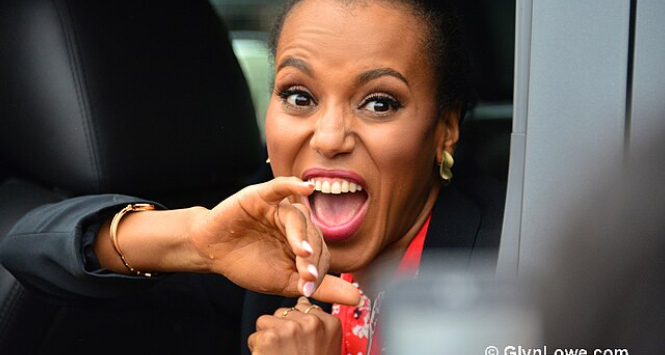
When Kerry Washington slipped into the sharp suits, crisp white coats, and power heels of Olivia Pope, fans of Scandal saw control personified.
But behind the camera, Washington was navigating a very different challenge — pregnancy. And now, years after the hit ABC series ended, she’s opening up about the creative clash and emotional insight that came from that period of her life.
During a recent appearance on Jake Shane’s Therapuss podcast, Washington revealed that she once asked Scandal creator Shonda Rhimes to weave her pregnancy into the show’s storyline.
“It was really wild because I begged Shonda to make Olivia Pope pregnant,” Washington admitted. “I was like, ‘I’m gonna be growing wider and wider, and I’m not going to be doing that Olivia Pope strut down the hallway — I’m gonna be waddling. It’s gonna be weird.’”
But Rhimes, known for her precise world-building and powerful female leads, turned down the request.
“She was like, ‘You have to figure it out. Olivia Pope cannot be pregnant,’” Washington recalled.

Still, Rhimes’s decision wasn’t rooted in a lack of empathy. Washington shared that her boss was overjoyed at the pregnancy news — even throwing her a baby shower — but stood firm that the storylines of Scandal couldn’t accommodate that level of vulnerability.
“When I became a mom, I got it,” Washington reflected. “Olivia Pope is like a superhero. And there’s an inherent vulnerability in becoming a mom — suddenly your heart is walking outside your body. Especially being the mother of a Black child, your heart is vulnerable to all these systems your child is up against. That’s why Olivia Pope couldn’t be a mom. She couldn’t be that vulnerable for anybody.”
The explanation offers a rare look into Rhimes’s creative philosophy — one that frames strength and emotional restraint as vital to Olivia Pope’s mythology.
As Washington put it, the realization was “intense,” reshaping how she viewed both motherhood and her character’s power.
Behind the scenes: hiding pregnancy in plain sight
Washington’s pregnancies coincided with Scandal’s filming, meaning she often worked 16-hour days while concealing her growing belly from the audience.
“I was hiding behind boxes, briefcases, chairs, and lamps,” she recalled. “I refused to be out of my heels. I was like, ‘I can’t walk in flats. I’m Olivia Pope.’”
Despite the physical toll, she said the experience deepened her admiration for working mothers everywhere.
“It taught me how to take cat naps,” she said with a laugh, adding that continuing to work helped her “enjoy my pregnancies more” because she was surrounded by people she loved.
A cultural turning point in TV history
When Scandal debuted in 2012, Washington’s portrayal of Olivia Pope — a brilliant, complex crisis manager navigating power and politics in Washington, D.C. — marked a breakthrough in Hollywood. She became the first Black woman to lead a network drama in nearly 40 years, opening the door for more diverse storytelling in primetime television.
That’s what makes this revelation more than just a behind-the-scenes anecdote — it’s a reflection of how representation and resilience intersect. Rhimes’s refusal to make Pope a mother wasn’t about denying humanity, but about protecting an archetype — a powerful Black woman who operated on her own terms in a world that rarely allowed that image to exist.
Kerry Washington’s story is both deeply personal and profoundly symbolic — a reminder that even off-screen, the women who play “fixers” often have to fix their own realities with quiet strength.