
In a viral Threads post, a woman reveals the strange privilege of growing up with “street legacy,” medical school tuition paid in cash, foreign cars bought like lollipops, yet feeling locked out of country clubs, private schools, and the invisible networks of the ultra-rich.
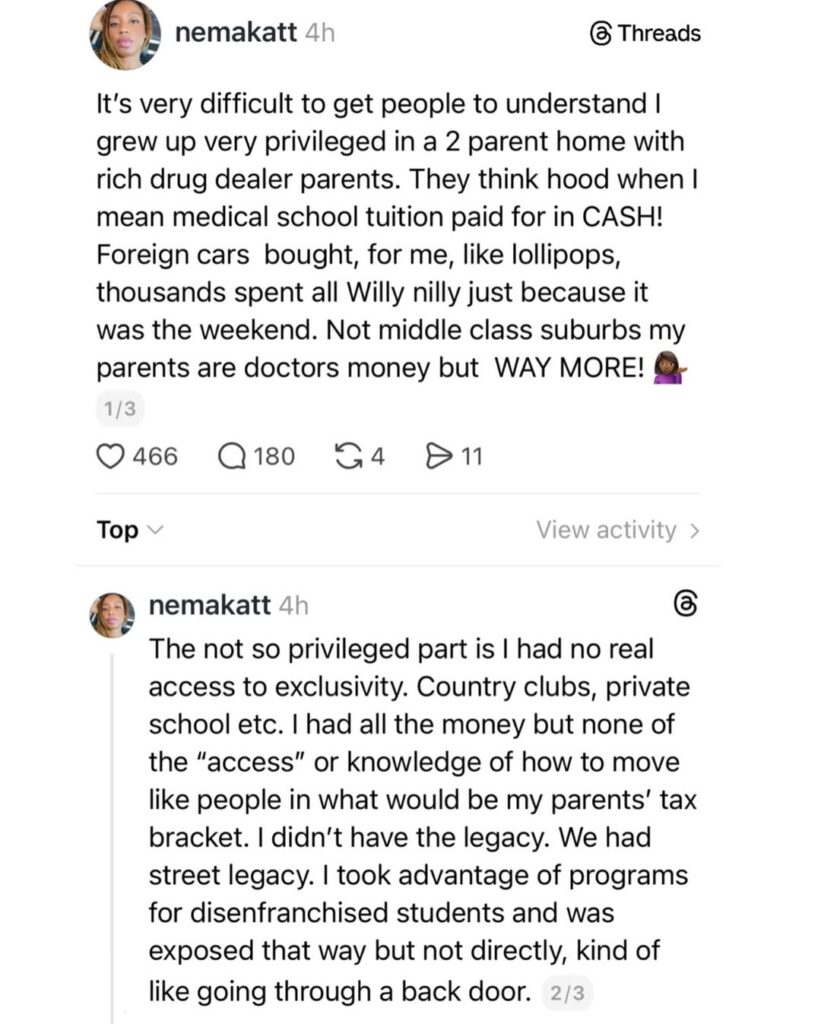
It is very difficult to get people to understand, writes Nemakatt. She grew up very privileged in a two-parent home with rich drug dealer parents.
When people hear that, they think hood. But she means medical school tuition paid for in cash. Foreign cars bought for her like lollipops. Thousands spent willy-nilly just because it was the weekend. Not middle-class suburbs. Not even doctors’ money. Way more.
But the not-so-privileged part, she says, was that she had no real access to exclusivity. No country clubs. No private school networks. She had all the money but none of the access or knowledge of how to move like people in what would be her parents’ tax bracket. She did not have the legacy. She had street legacy.

Money vs. Access: A Viral Distinction
The anonymous woman, posting under the handle nemakatt on Threads, has sparked a wide-ranging conversation about the hidden hierarchies within wealth itself. Her three-part thread, viewed hundreds of thousands of times, draws a sharp line between having money and having access, the social capital, insider knowledge, and generational networks that truly open doors.
“I took advantage of programs for disenfranchised students and was exposed that way but not directly,” she writes. “Kind of like going through a back door.”
The Upper Middle Class Trap
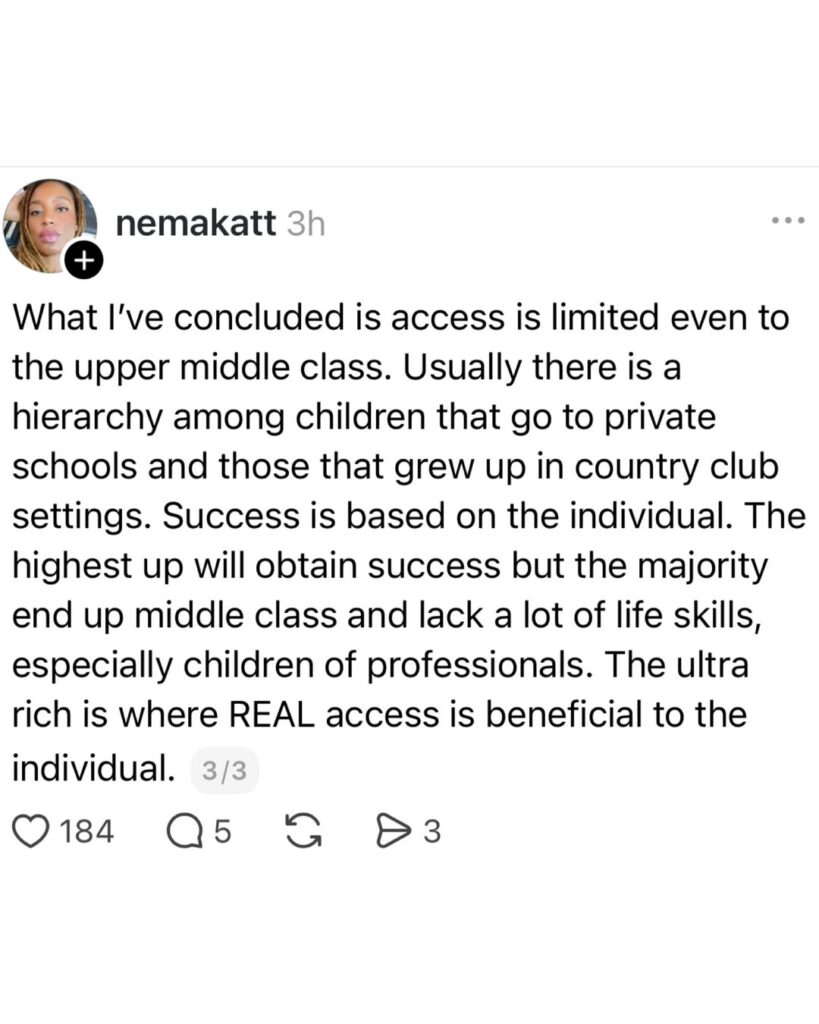
In her concluding post, she offers a sweeping observation about class in America. Access is limited even to the upper middle class, she argues.
There is a hierarchy among children who go to private schools and those who grow up in country club settings. Success, she says, is based on the individual. The highest up will obtain success, but the majority end up middle class and lack a lot of life skills, especially children of professionals.
The ultra-rich, she concludes, is where real access is beneficial to the individual.
A Window Into Invisible Class Barriers
The thread has resonated with readers who have experienced similar contradictions: growing up with financial comfort but feeling excluded from the exclusive institutions and unwritten rules that privilege the traditionally wealthy.
Unlike old money families who pass down both capital and cultural knowledge, new money, and particularly wealth derived from illicit economies, often comes without the social roadmap.
One commenter summarized the dynamic: “Money buys the car. Access buys the invitation to the country club where the car is parked.”
What the Thread Reveals
The woman’s posts touch on several under-discussed aspects of class in America:
- The distinction between wealth and belonging. You can have cash but still feel like an outsider.
- The limits of new money. Without generational networks, even the rich can be locked out.
- The hidden curriculum of elite spaces. Country clubs, private schools, and legacy admissions operate on rules that money alone cannot teach.
- The precariousness of professional-class children. Many, she argues, lack life skills and fail to maintain their parents’ status.
A Broader Conversation
The thread has been shared across social media platforms, with users adding their own experiences of being “rich but not connected” or “comfortable but not invited.” Others have pushed back, arguing that any level of wealth provides advantages that most Americans cannot imagine.
But the woman’s central claim, that there is a meaningful difference between having money and having access, has struck a nerve. In a society increasingly aware of how class shapes opportunity, her story offers a rare glimpse into the hierarchies that exist even among the privileged.
As she puts it: she had all the money. But none of the access. And that, she suggests, made all the difference.