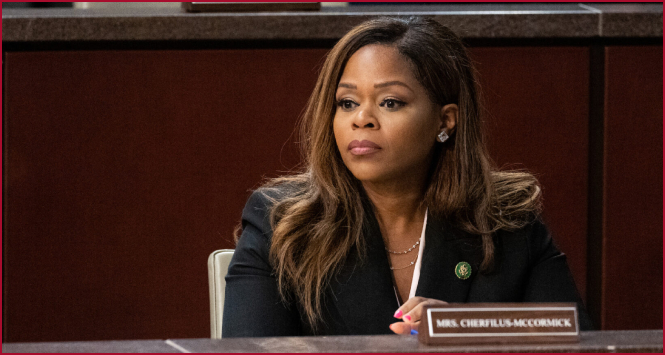
U.S. Rep. Sheila Cherfilus-McCormick (D-FL) is facing a sweeping ethics and campaign finance investigation stemming from a controversial $5.8 million overpayment her healthcare company received from the state of Florida during her congressional campaign.
The Office of Congressional Ethics (OCE) and the House Ethics Committee are reviewing allegations that Cherfilus-McCormick accepted contributions linked to official actions and failed to properly disclose campaign finances.
The scrutiny intensified after watchdog group Foundation for Accountability and Civic Trust (FACT) submitted a formal request for a Department of Justice (DOJ) investigation, citing potential criminal violations.
Background on the Overpayment
At the heart of the inquiry is a massive invoice submitted by Trinity Health Care Services, where Cherfilus-McCormick served as CEO, to the Florida Division of Emergency Management during the COVID-19 pandemic.
The agency claims the invoice led to a $5 million overpayment—funds that were not returned and only recently became subject to a 15-year repayment agreement between Trinity and the state.
According to FACT, the $5.8 million influx did not correspond with a notable increase in the congresswoman’s personal assets as disclosed in her federal financial reports, raising red flags about transparency and the potential misuse of funds.
“Despite the increase in income, her assets did not notably increase as shown on her congressional financial disclosure reports,” FACT said in its referral to the DOJ. “The facts, timeline, and dollar amounts are plainly incriminating.”
Ethics, Campaign Finance, and Disclosure Concerns
In addition to the overpayment, Cherfilus-McCormick is accused of misrepresenting the source of campaign funds and failing to disclose in-kind contributions that may have exceeded Federal Election Commission (FEC) limits.
Her 2021 campaign for Florida’s 20th Congressional District—one of the most expensive self-funded campaigns in the state’s history—has come under intensified examination.
FACT Executive Director Kendra Arnold called on the DOJ to step in, stating, “Historically, the Ethics Committee has not been timely nor reliable in assuring justice when it involves their own Members.”
“Both the stakes and the evidence involved here fully merit involvement by the highest investigative and enforcement body in our government,” Arnold said. “The Department of Justice should fully investigate this matter to ensure accountability and uphold public trust in our democratic institutions.”
A Broader Pattern of Congressional Ethics Scrutiny
The investigation into Rep. Cherfilus-McCormick adds to a growing list of House members facing ethics scrutiny over financial dealings and potential misuse of COVID-19 relief funds. While no formal charges have been filed, the allegations raise serious questions about oversight of pandemic-related funds and the intersection of personal business interests and public office.
Cherfilus-McCormick has not issued a formal public response to the allegations or FACT’s referral to the DOJ. However, political observers note that the situation could jeopardize her standing within the Democratic caucus and her re-election prospects in a competitive South Florida district.
What Comes Next
The House Ethics Committee has not confirmed whether it has launched a formal investigation, but the OCE’s review could trigger a full congressional ethics probe. Should the DOJ act on FACT’s referral, it could lead to subpoenas, financial audits, and potential legal consequences.
The $5.6 million repayment agreement between Trinity and the state of Florida will unfold over the next 15 years, with quarterly payments required. Whether Cherfilus-McCormick remains politically viable through that period remains to be seen.
For now, the spotlight is firmly on Capitol Hill’s latest ethics scandal—one that could ripple through both Congress and the Department of Justice.