
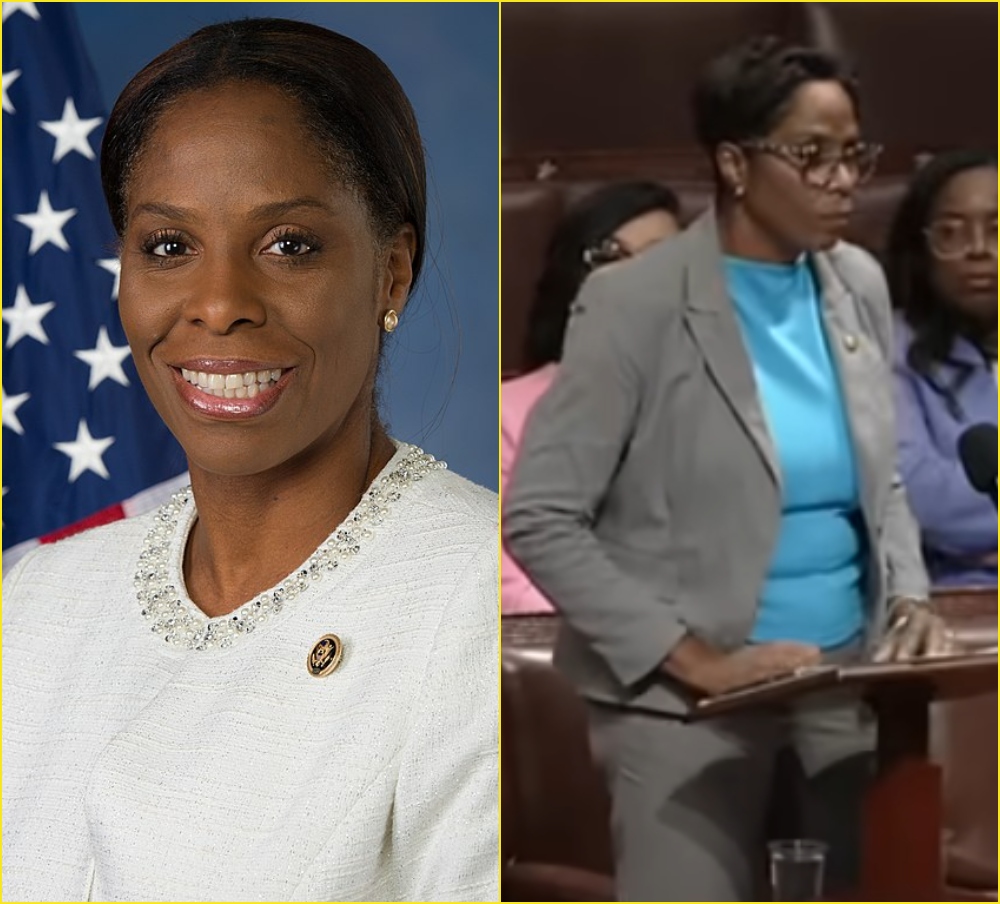
Rep. Stacey Plaskett (D–U.S. Virgin Islands) forcefully defended herself on the House floor Tuesday, Nov 18, 2025, as Republicans sought to censure her over newly released records showing she exchanged text messages with Jeffrey Epstein nearly seven years ago.
The messages were sent during Michael Cohen’s explosive 2019 testimony about Donald Trump.
Plaskett called the effort nothing more than “political theater,” arguing that she neither sought advice from Epstein nor relied on him in her questioning.
“I don’t need anyone to tell me how to question a witness,” she said, citing three decades as a lawyer, a narcotics prosecutor, and a Justice Department appointee. “I know how to seek information. I know how to get to the truth.”
The Texts And The Politics
The controversy erupted after the House Oversight Committee released thousands of pages of documents from Epstein’s estate, including messages showing the disgraced financier texting Plaskett during Cohen’s testimony. Epstein — then still alive, a constituent of Plaskett’s, and not yet publicly known to be under federal investigation — flagged names and reacted in real time.
The texts reveal no evidence of illegal activity or coaching, but Republicans quickly seized on the optics. Notably, GOP lawmakers have not accused Plaskett of wrongdoing — only of poor judgment.
Plaskett reminded her colleagues that the exchange was reviewed by federal courts and that civil claims against her were dismissed. She also noted she donated past campaign contributions from Epstein to women’s organizations in her community once his crimes came fully to light.
“Jeffrey Epstein’s actions were reprehensible,” she said. “I would never risk my law degree or my integrity for any individual — least of all him.”
Counterpunch On House Floor
What drew the most attention, however, was Plaskett’s sharp rebuttal to Republicans invoking the word “felon.”
“You want to talk about texting felons?” she said. “How often do you text President Donald J. Trump? That’s the individual we should be concerned about.”
Plaskett’s statement triggered an immediate objection from GOP members — who insisted she could not call the president a felon on the House floor — but the presiding officer ruled the point of order not timely, allowing Plaskett to continue.
With visible frustration, she accused Republicans of ignoring their own party’s ties to powerful abusers while pretending to champion victims.
“It’s not about sexual assault,” she said. “It’s about money. It is always about money.”
Plaskett said she has consistently fought against the exploitation of women and children, both before and during her time in Congress.
“They’ve weaponized a benign text exchange because they have nothing else,” she said. “This is about intimidation — and it will pass.”
Humanizing The Moment
At one point, Plaskett’s voice cracked as she spoke of working full-time with young children while attending law school at night. “Do you think I would risk my law degree for any individual? Never.”
She turned directly to her constituents:
“To the people of the Virgin Islands — we don’t back down from a fight. That’s how we won our freedom, and that’s how we will continue to stand tall.”
Whether the censure attempt advances or fizzles, Plaskett’s rebuttal reflects a broader reality: In a Congress increasingly shaped by social-media skirmishes and partisan brinkmanship, optics — not evidence — often drive the story.



_0.jpg)