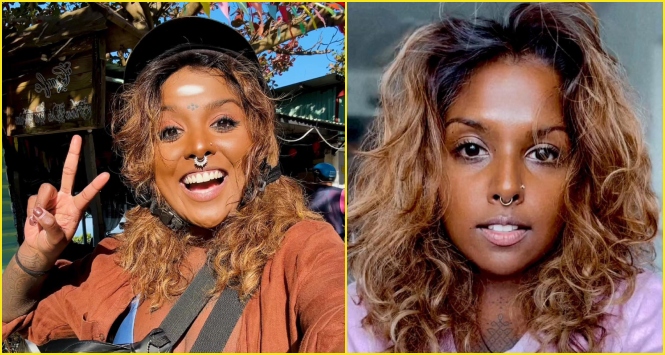
A digital creator’s raw plea against colourism is gaining respect across social media. Her honest delivery has sparked a renewed conversation about how deep-rooted prejudice against dark skin continues to shape beauty standards in Indian communities worldwide.
Nandini Balakrishnan (@nandinibalakrish), whose commentary-driven videos have steadily built a committed following, posted a 60-second monologue asking a question many dark-skinned South Asians have carried for generations: “Why is dark skin so hated?”
Her video, now circulating rapidly across Instagram and TikTok, is a sharply delivered cultural critique wrapped in personal frustration — and a reminder that colourism is less a “preference” and more a legacy of colonial conditioning.

Balakrishnan points to a contradiction often ignored in contemporary Indian discourse: the very gods millions worship are dark-skinned.
“Krishna literally means the dark one,” she says. “Rama, dark like the rain cloud… Kali and Vishnu, dark blue — the colour of divine.”
Her point lands with clarity: the ancient symbols South Asians hold sacred never associated darkness with inferiority.
“If darkness was ugly,” she asks, “why did the gods wear it with so much pride?”
But the video quickly pivots to what she calls the turning point — when darkness stopped being a shade and became something to “fix.”
She names the familiar culprits: decades of fairness-cream marketing, skin-lightening soaps, and films where darker-skinned characters are replaced by brown-painted actors rather than cast authentically.
Her argument is unflinching: colourism did not emerge from Indian tradition. “They didn’t just colonise lands,” she says, “they colonised our minds.”
Fairness became aspirational, darkness undesirable, and consumer companies — Indian and Western — capitalised on the insecurity.
Balakrishnan’s video also revisits the psychological residue of colonial rule: the subconscious hierarchy that equates lighter skin with success, beauty, or civility — a mindset she calls “the colonial hangover.”
“It runs real deep,” she adds. “Because the oldest traditions say dark is divine. The new one just sells you bleach.”

The commentary is striking not because it is new, but because it is personal and uncompromising.
More pointedly, her video calls out a billion-dollar industry still thriving on this insecurity. While some companies have rebranded fairness creams in recent years — swapping “fair” for “glow” or “brightening” — the underlying message, critics note, has barely changed.
Balakrishnan ends her video with a simple call:
“Stop buying it. The colour isn’t the problem — the lie is.”
In a region where beauty norms influence everything from marriage prospects to casting decisions, her words hit a nerve. And in a digital ecosystem now amplifying voices previously sidelined, creators like Balakrishnan are reminding audiences of an uncomfortable truth: India may have rejected colonial rule, but the colonial mindset still lingers in the mirror.
If her post is any indication, many South Asians are ready — finally — to challenge it.