
In a pair of incisive Instagram posts, content creator Ashley B (known online as @ashleytheebarroness) took aim at conservative Christian influencer Erika Kirk, warning that her polished faith branding may disguise a deeper ideological agenda.
“Sanitized extremism is still extremism. The soft voice. The curls. The Christian branding. It’s the same old control wrapped in a prettier bow,” Ashley B wrote, laying out a compelling critique of how faith, femininity, and political power intersect.
Her commentary comes amid Erika Kirk’s heightened visibility following the assassination of her husband, Charlie Kirk, and her ascension as a key figure in the conservative movement.
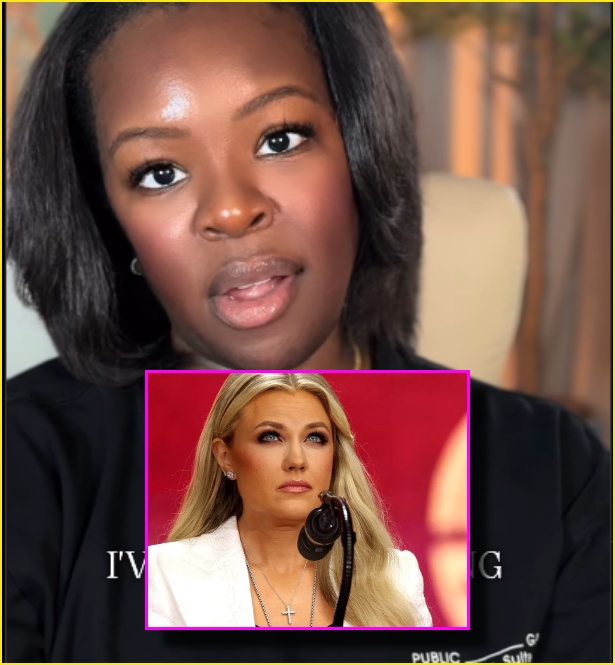
The Tone, The Brand, The Influence
In her video post, Ashley B methodically described how Erika Kirk moves and markets herself: from tears on cue to the role of the “holy widow,” “beautiful believer,” and “vessel for the message.”
“When your public grief starts looking like an Adam and Eve commercial, that’s not faith. That’s branding,” Ashley B said.
“She wraps white Christian nationalism in soft femininity… She’s not sending liberation — she’s selling comfort.”
Her message is clear: the visual and emotional packaging of faith can no longer be viewed as simply benign or aesthetic when the politics behind it are powerful and, some argue, exclusionary.
Why the Concern?
Erika Kirk is a high-profile figure: former Miss Arizona, started faith-based media ventures, and, after her husband’s death, stepped into a leadership role at Turning Point USA (TPUSA).
The Los Angeles Times, Washington Post and other outlets have noted how her rapid-rise signals a changing moment for conservative Christian women in politics.
What Ashley B highlights is how this polished persona may serve a broader movement — one that demands deeper scrutiny. She warns that when a woman becomes the aesthetic “face” of a cause, she may be indispensable until she is no longer useful.
“When your brand becomes a faith-based fairytale, you start serving a system that’ll never serve you back,” Ashley B wrote.
A Broader Framework: Faith Meets Politics
This critique touches on a wider conversation: the role of faith influencers in shaping political movements. As Erika Kirk’s profile rose, media analysts described her as “redefining the role of a political widow” and positioning herself as a maternal-symbol for the next generation of conservative Christian women.
Ashley B’s commentary resonates with those questioning the intersection of faith, femininity, and power:
- When does ministry end and movement begin?
- When does vulnerability become brand strategy?
- Who benefits when faith is repackaged as a pathway to political power?
A Call for Vigilance
In many ways, Ashley B’s social media critique acts as a civic alarm bell. It’s not necessarily about Erika Kirk personally, but about the system she occupies — a system that uses religious imagery, emotional storytelling, and curated femininity to mobilize, brand, and influence.
For faith communities, this is a moment to reflect: Are we witnessing genuine service, or a well-crafted echo chamber? For women drawn to leadership, the warning is explicit: influence may come with fine print.
“Props are always replaceable,” Ashley B concluded in the video. “When the camera moves, the script changes — and the woman blessed by the movement may become the first one benched.”
Ashley B’s critique asks all of us: Are we looking beneath the image? Because the face of faith may be the most effective mask of all.


