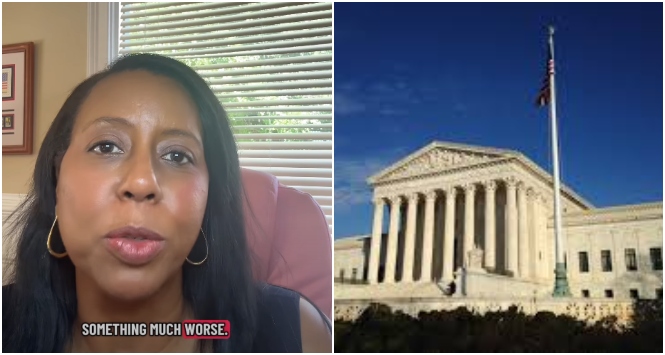
A prominent attorney and legal commentator is encouraging Americans not to lose hope following a controversial U.S. Supreme Court decision that critics say significantly weakens protections under the Voting Rights Act.
Danielle Bess, known online as @imalawyerinreallife, shared a video breaking down the Court’s 6-3 ruling in Louisiana v. Callais, warning that while the law was not formally struck down, its practical impact has been severely diminished.
“They didn’t strike down the Voting Rights Act. They did something worse, they ‘updated’ it into uselessness,” Bess said, describing the ruling as a major shift in how voting protections are interpreted and enforced.
The case centered on whether Louisiana could be required to create a second majority-Black congressional district after courts previously found its map violated Section 2 of the Voting Rights Act. According to Bess, the Supreme Court’s decision could now place long-standing majority-Black districts across the South in legal jeopardy.
She pointed to potential ripple effects in multiple states, suggesting districts in Louisiana, Alabama, and Georgia, many created or preserved through decades of civil rights litigation, could face new legal challenges ahead of future elections.
Legal analysts say the ruling may alter how courts evaluate claims of racial vote dilution, particularly in redistricting disputes. Critics argue it could make it harder to challenge maps that reduce minority voting power, while supporters say it clarifies constitutional limits on race-based districting.
Despite her concerns, Bess struck a notably hopeful tone, urging civic engagement rather than resignation.
“The Voting Rights Act has no teeth anymore, but does that mean we are in a completely hopeless place? I don’t think so,” she said. “There is still power in our vote… They can change the rules, they can gut the framework, but they cannot make us give up.”
Her message has resonated widely on social media, where users have shared calls to action around voter participation, advocacy, and legislative reform in response to the ruling.
The decision comes amid broader national debates over election laws, redistricting, and access to the ballot, with voting rights groups already signaling plans for further legal challenges and legislative efforts to restore protections.
As the legal and political implications of the ruling continue to unfold, voices like Bess’s are urging resilience and participation. These voices are urging Black people that the decision is not an endpoint but a turning point in the ongoing fight for voting rights in the United States.