
A coalition of prominent activists, artists, elected officials, authors, and survivor advocates has launched a nationwide campaign calling for accountability, healing, and justice for survivors of gender-based violence, declaring that “the time has come” for action after decades of what organizers describe as systemic failures.
The campaign, “Disrupt the Injustice: 60 Million Survivors Rising,” was unveiled through a powerful video featuring voices including author and activist V, Kimberlé Crenshaw, Anita Hill, Ashley Judd, and Pramila Jayapal.
At the center of the initiative is a stark message: survivors are tired of waiting.
“We rise for the over 60 million survivors in this country,” participants declared in the campaign video. “We will not stop until the violence stops.”
“The Time Has Come for Justice”
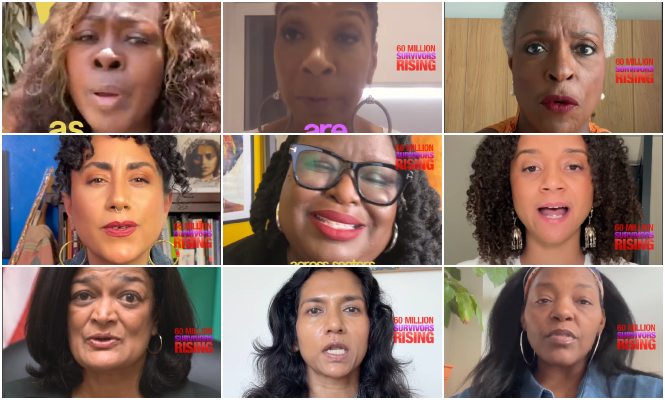
The campaign argues that violence against women and gender-expansive people remains a widespread and deeply embedded social problem, despite years of advocacy and public awareness efforts.
“We as women and gender expansive people in the United States are outraged by the absence of accountability for abusers, by the lack of care for survivors, by the disregard for their suffering,” speakers said in the video.
The coalition says it is bringing together people from different communities, generations, and professions to demand what it calls a new era of accountability:
“We are coming together across sectors, across communities, across generations to say the time has come for justice, accountability and healing.”
Citing Rising Concerns
Campaign organizers pointed to several recent developments they say underscore the urgency of the movement.
Among the issues highlighted were rising rates of domestic violence affecting Black women, the spread of AI-generated deepfake images targeting girls, ongoing debates surrounding the release of records connected to convicted sex offender Jeffrey Epstein, and concerns over laws affecting reproductive rights and transgender communities.
“We have witnessed a devastating escalation of violence against women and gender expansive people,” the speakers said.
The campaign also referenced what it described as broader cultural and institutional failures that allow abuse to continue unchecked:
“What we are witnessing is not isolated. It is systemic, it is cultural and it is sanctioned by those in the highest offices in this country.”
A Culture of Rape Does Not Exist in Isolation
One of the campaign’s most striking statements framed gender-based violence as a societal issue rather than a collection of individual incidents.
“A culture of rape does not exist in isolation,” the speakers said. “It is upheld by power, protected by silence and reinforced by institutions.”
The coalition argues that when influential figures excuse harmful behavior or avoid accountability, they contribute to environments where violence and abuse become normalized.
“When those in power model harm, excuse harm or embody harm, they normalize violence against women and gender expansive people,” the video states.
Standing With Survivors
Organizers state that the campaign is intended to represent all survivors, including those who have spoken publicly and those who remain silent out of fear.
“We stand with the Epstein survivors,” participants said. “We stand with survivors across this country still fighting for justice, for healing, for recognition, for accountability.”
The campaign also acknowledged survivors who have not yet come forward: “We stand with survivors who remain silent, afraid of the risk of finally speaking out.”
A National Call to Action
The movement is encouraging supporters to sign its public statement, share survivor stories, and participate in a National Day of Action scheduled for September 26.
For organizers, the campaign represents more than a protest. It is an attempt to unite millions of people around a shared demand for change.
“The time has come for women and for all people to rise and say no more,” the coalition declared.
As conversations around gender violence, accountability, and survivor advocacy continue to shape public discourse, organizers hope the campaign’s central message resonates across the country: survivors have waited long enough.

