
“They cutting off food stamps. Maybe it’s time we eat the rich.” Those words, written by poet and creative Onyia Ali (@onyiatheoriginal on Instagram), are gaining respect online as millions of Americans confront rising costs, frozen benefits, and the emotional toll of simply trying to survive.
Ali’s post, both poetic and piercing, arrived at a time when a prolonged government shutdown and stalled assistance programs have left working families in limbo. Beneath the art lies a truth too many people recognize: it’s not about envy—it’s about exhaustion.
“I have a full-time job, a business, and I do poetry on the side,” Ali wrote. “I still live paycheck to paycheck.”
That admission, layered with her reflections on inequality, hunger, and collective struggle, struck a nerve. Her message, she explained, was never about resentment—it was about empathy.
A Voice for the Working Exhausted
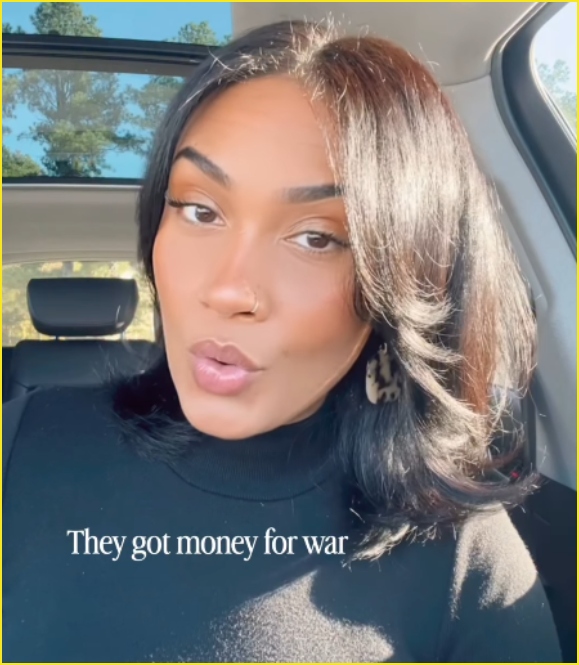
Ali’s poem, delivered in a video that’s now being widely shared, blends raw emotion with rhythmic urgency:
“They got money for war, won’t feed the poor… maybe it’s time we eat the rich.”
It’s a callout that feels more symbolic than literal—an expression of outrage at a system where billionaires thrive while families skip meals. In a climate where food stamp access is shrinking and grocery prices remain stubbornly high, her words have become a mirror for a struggling nation.
Through her verses, Ali gives language to a reality that many quietly endure: full-time workers still seeking food banks, parents juggling multiple jobs yet falling short of stability, and communities forced to question what “prosperity” really means.
“I’m not complaining,” she clarified in her post. “I know what it feels like to be hungry. I’ve had to visit food banks for help. I’ve been on the brink of eviction before.”
Her honesty dismantles the myth that financial hardship equates to laziness or failure—it’s the symptom of imbalance in an economy that rewards accumulation over compassion.
The Power Behind the Art
Beyond its viral traction, Ali’s message underscores a deeper tension in the national conversation about wealth inequality. The top 10 percent of Americans now hold roughly two-thirds of the nation’s wealth, while millions teeter at the poverty line despite working harder than ever.
Ali’s statistics make the contrast visceral: “One billion dollars is 1,000 million. The richest person in the world has $493 billion. It would take $330 billion to eliminate world hunger by 2030.”
For many, that math is impossible to ignore.
Her words echo a growing frustration among artists, activists, and everyday citizens who feel that the American dream has become a luxury brand—available only to those who can afford the entry fee.
Commentary: When Art Becomes Protest
Art has long been a vessel for social truth, and Ali’s poem falls squarely within that lineage—from Langston Hughes’ “Let America Be America Again” to Gil Scott-Heron’s “The Revolution Will Not Be Televised.” Her work channels that same energy, updated for the digital age, where viral poetry can serve as both protest and prayer.
While some online critics have dismissed “eat the rich” as incendiary, many others see it as a metaphor for accountability—a demand that those with power and resources recognize their role in an increasingly unlivable economy.
At its core, Ali’s message is less about anger and more about awakening.
“I am speaking for those who may not be able to,” she wrote. “That’s love. That’s humanity.”
As political gridlock deepens and essential aid programs hang in uncertainty, Onyia Ali’s poem has become a rallying cry for those who feel unseen.


