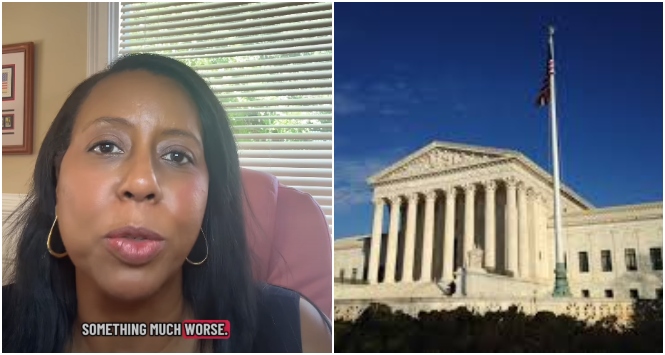
Attorney and legal commentator Danielle Bess says an underreported emergency filing before the Supreme Court of the United States could have lasting consequences for future judicial elections in Georgia, even though the state’s Supreme Court race has already ended.
“The core question is still on the table,” Bess said in a video posted to Instagram while discussing the ongoing legal dispute. “Can the JQC silence candidates the way they tried to do Miracle and Jen?”
The case centers on Georgia Supreme Court candidates Miracle Rankin and Jen Jordan, who filed an emergency application asking the U.S. Supreme Court to vacate a stay issued by the United States Court of Appeals for the Eleventh Circuit.
The stay allowed the Georgia Judicial Qualifications Commission, or JQC, to publicly release letters alleging potential campaign rule violations before any full investigation had been completed.
According to Bess, Rankin and Jordan sued the JQC after receiving letters suggesting they may have violated judicial campaign rules. A federal judge initially granted a temporary restraining order blocking the public release of the allegations.
However, the JQC quickly appealed, and the Eleventh Circuit later paused the restraining order, allowing the agency to release the letters before the election.
Bess argued the timing of the disclosures raised serious constitutional concerns and may have influenced voters during the high-profile judicial race.
“We’ll never know what effect that had on the outcome of the race for the Georgia Supreme Court,” she said.
The attorney also noted that emergency applications to the Supreme Court face an extremely high legal standard and are rarely successful. Still, she pointed to a significant development in the case involving Clarence Thomas.
“Clarence Thomas did not reject the emergency application filed by Miracle and Jen,” Bess said. “Instead, he instructed the JQC to file a response by May 21st at noon.”
Because the response deadline falls after the election, the case is unlikely to alter the race’s outcome. But Bess said any eventual Supreme Court action could help define how far state judicial oversight agencies can go when handling allegations against candidates during active campaigns.
At the center of the dispute are broader constitutional questions involving free speech and due process protections under the First and Fourteenth Amendments.
“Were the First Amendment and Fourteenth Amendment rights of Miracle and Jen violated by what the JQC did?” Bess asked.
As of now, the emergency application remains active before the Supreme Court while the Georgia Judicial Qualifications Commission prepares its formal response.