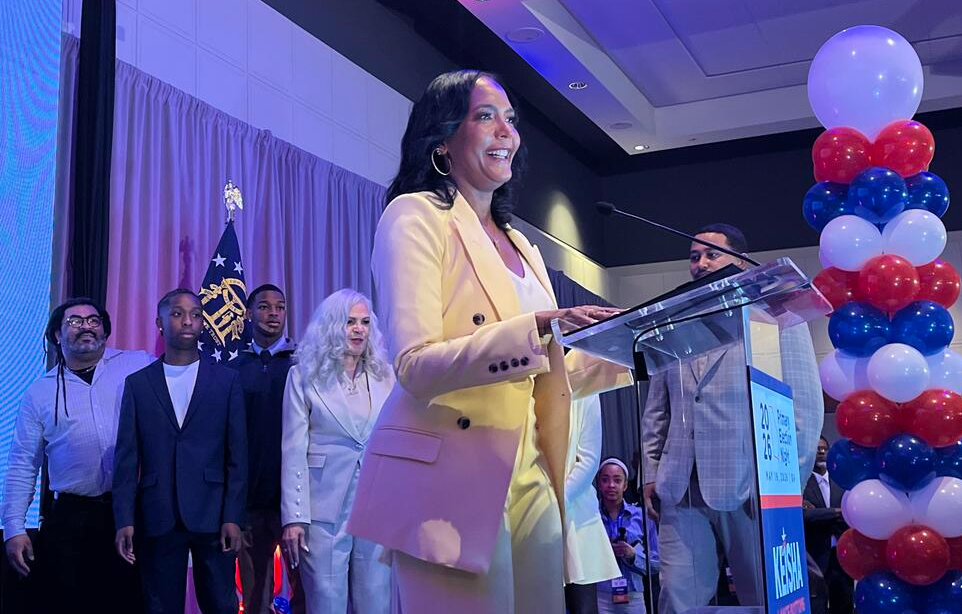
Former Keisha Lance Bottoms secured the Democratic nomination for governor of Georgia on Tuesday, delivering a decisive victory that avoided the runoff many of her rivals had hoped would test concerns about her general election prospects.
The outcome gives Bottoms an early advantage as Democrats shift toward unifying for November, while Republicans remain locked in a contentious and expensive primary battle. On the GOP side, billionaire Rick Jackson and Georgia Lt. Gov. Burt Jones advanced to a runoff after a campaign marked by heavy spending, sharp attacks and repeated efforts to demonstrate loyalty to President Donald Trump.
Bottoms’ victory validates a strategy centered on broad name recognition, executive experience and the argument that she is Democrats’ strongest candidate to compete against a Trump-aligned Republican.
“The choice this November will be clear,” Bottoms said after her win. “Burt Jones and Rick Jackson have spent their lives enriching themselves and are running for governor to do just that. I’ll be a governor who will always fight for you.”
Avoiding a runoff also shields Bottoms from a prolonged intraparty battle that could have reopened scrutiny of her time leading Atlanta during the coronavirus pandemic, racial justice protests and public safety controversies.
Her top Democratic challengers, including former Lt. Gov. Geoff Duncan, former state Sen. Jason Esteves and former DeKalb County chief executive Michael Thurmond, argued they were better positioned to unite Democrats and appeal to swing voters in a state where Republicans have controlled the Governor’s Mansion for nearly a quarter century.
Throughout the campaign, Bottoms promoted policies including expanding Georgia’s pre-K program, broadening Medicaid access, eliminating state income taxes for teachers and placing casino gambling before voters. Her candidacy also benefited from visibility earned both as mayor of Atlanta and as a senior adviser to former President Joe Biden, who endorsed her campaign.
Still, questions remain within parts of the Democratic coalition about whether controversies from her mayoral tenure could become liabilities in November. Critics have pointed to unrest during her administration and her decision not to seek reelection as mayor as vulnerabilities Republicans could exploit.
Bottoms has pushed back by recasting her record as one of practical leadership. On the campaign trail, she highlighted economic development efforts, support for raising police pay and backing for Atlanta’s controversial public safety training center, presenting herself as a leader willing to balance public safety with community priorities.
At polling places across Atlanta, voter reactions reflected those competing views. Some voters praised her leadership and decision-making, while others voiced frustration over issues such as housing affordability and transit development.
Bottoms entered the race as the clear front-runner after several prominent Democrats declined to run, including two-time gubernatorial nominee Stacey Abrams, Jason Carter and U.S. Rep. Lucy McBath. Now, with the primary behind her, she turns toward a general election campaign that Democrats hope could end the GOP’s decades-long hold on Georgia’s top office.