
Trinity Rodman may carry one of basketball’s most recognizable surnames, but her rise in professional soccer is powered by her own brilliance—explosive, historic, and entirely self-authored.
At 23, the Washington Spirit forward has signed a landmark $1.1 million contract, making her the highest-paid player in National Women’s Soccer League (NWSL) history. The deal, first inked at age 20 and now affirmed as one of the most consequential in U.S. women’s sports, underlines Rodman’s swift ascent from prodigy to powerhouse.
The multi-year contract catapulted her past league giants like Alex Morgan and Megan Rapinoe, each previously earning around $250,000 annually—an extraordinary leap in a league still fighting for financial parity. Rodman’s $281,000 yearly base salary is a clear signal that the NWSL is entering a new era, one where elite performance commands elite compensation.
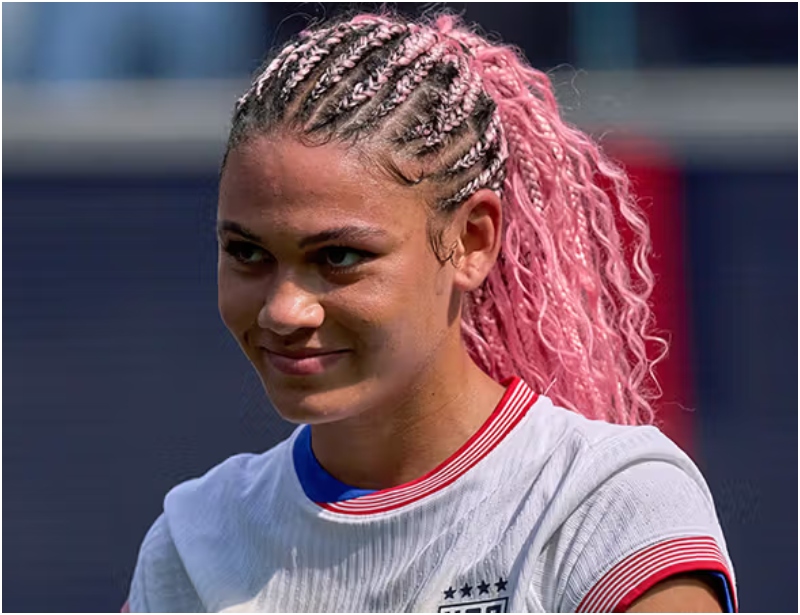
Her résumé justifies every dollar. Rodman was the NWSL’s youngest draft pick ever, Rookie of the Year, a U.S. women’s national team standout, and even a Ballon d’Or finalist—all before turning 21. Coaches describe her as a generational talent. Fans see her as a breath of fresh energy. And executives see proof that investing big in women’s sports is not only fair—it’s smart business.
“She has a truly special career ahead of her,” former Spirit coach Kris Ward said at the time of the signing. “She makes us a better club on all fronts.”
The deal also coincided with the NWSL’s first collective bargaining agreement, which raised salaries league-wide and expanded the financial tools teams can use—such as allocation money—to reward top-tier performers like Rodman.
But this milestone didn’t unfold in a vacuum. Washington Spirit faced a turbulent offseason marked by allegations of coaching abuse and a bitter ownership conflict. Rodman’s breakout performances, leadership presence, and long-term commitment provided a stabilizing spotlight at a moment when the club desperately needed one.
Her international résumé continues to grow. Rodman accepted her first U.S. women’s national team call-up shortly after the historic deal and has since become one of the program’s rising stars—underscoring her impact beyond club football.
What sets Rodman apart, however, isn’t only her athleticism; it’s her positioning as a symbol of shifting power in women’s sports. Her record-breaking contract does more than reward a single athlete—it challenges an entire industry to rethink value, investment, and the markets women athletes are building.
For a generation of young players, including those far beyond the United States, Rodman’s deal sends a message: the ceiling is moving higher.
And for women’s soccer globally, it marks a turning point. Ambition is not just allowed—it’s finally being paid for.

