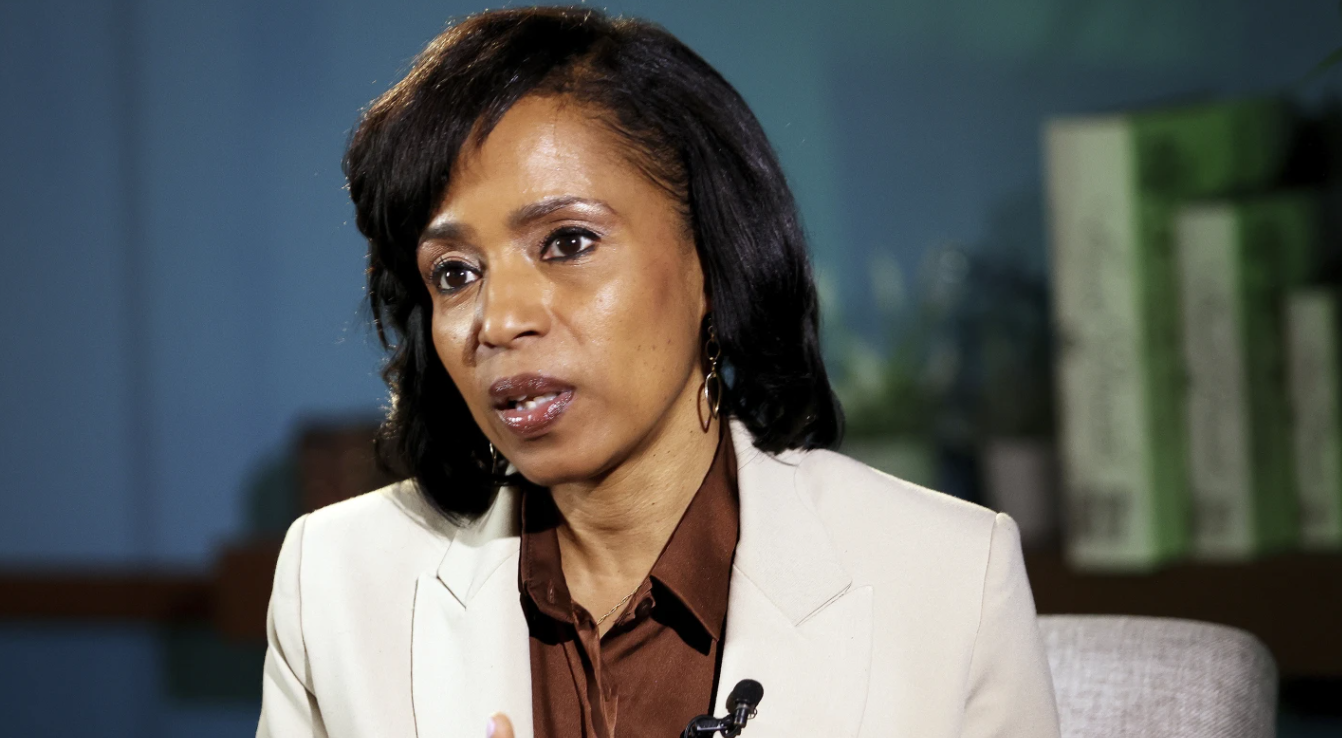
Senator Angela Alsobrooks took direct aim at President Donald Trump, accusing him of misleading Americans and worsening the struggles of working families.
Her remarks, delivered at a recent public event, offered both a stinging critique of economic inequality and a heartfelt message of solidarity to federal workers caught in the political crossfire.
“Donald Trump lied when he said that he was going to bring down the cost of groceries. He lied when he said he was going to make life better for all of us,” Alsobrooks declared. “The only lives that have improved have been the billionaires.”
Her strong words touched on inflation, economic uncertainty, and partisan brinkmanship in Washington.
The senator’s pointed criticism comes amid rising food prices, tariff-driven costs, and the lingering effects of federal agency disruptions that have impacted thousands of workers across the country — particularly in her home state of Maryland, where a large portion of the workforce depends on federal employment.

Standing Up for Federal Workers
Alsobrooks, known for her sharp political instincts and empathetic tone, spoke passionately about the human toll of government shutdowns and budget standstills — issues that disproportionately affect middle-class workers.
“These are not numbers, these are humans,” she said. “These are people with lives and families and children.”
She referenced widespread layoffs and instability within federal agencies like the Internal Revenue Service, describing the situation as “unjust and unjustified.” Her remarks evoked the pain of federal employees who face job insecurity, delayed paychecks, and reduced benefits — all while being vilified in political debates.
Her use of the Dr. Martin Luther King Jr. quote — “the arc of the universe is long, but it bends toward justice” — underscored her faith that the nation would eventually recover from what she called a period of “immorality” and “evil” in governance.
“We woke up on this morning, and this is what we have faced,” she told the audience, “but there will be another morning that will surely come.”
A Sharp Rebuke of Trump-Era Economics
Alsobrooks’ speech also took aim at Trump’s economic legacy, arguing that his policies — including tariffs and tax breaks for the wealthy — have done little to help average Americans.
According to Alsobrooks, while billionaires continue to amass record wealth, groceries have risen roughly 3% this year, and essential services like hurricane prediction and cancer research have suffered under budget constraints. Her criticism points to a larger national debate: whether the promise of “America First” has come at the expense of everyday Americans struggling to afford basic needs.
Her closing message was unflinching:
“The Republicans would prefer to shut down the government than to ensure your family has affordable healthcare,” she said. “It’s more than shameful — it is immoral, and it will hurt our country for generations to come.”
The Moral Politics of Governance
Alsobrooks’ remarks reflect a broader ideological struggle shaping American politics: the tension between fiscal conservatism and moral governance. Her framing of the issue as “immorality” rather than mere “partisan obstruction” signals a shift in tone among Democrats who are increasingly speaking in moral — not just economic — terms.
Her language of justice, compassion, and perseverance resonates with the same rhetorical traditions that have historically mobilized grassroots movements. By connecting the plight of federal workers to larger themes of dignity and fairness, Alsobrooks positioned herself as both an advocate and a moral voice — one willing to confront what she described as a “cycle of cruelty” embedded in political decision-making.
Why Alsobrooks’ Message Matters Now
Under Trump’s administration, defined by economic frustration and deep political divisions, Alsobrooks’ message stands out for its emotional clarity. Her speech goes beyond criticism — it’s a call to conscience, aimed not only at policymakers but at voters themselves.
As she told the crowd, “This evil cannot last.” It was both a warning and a promise.