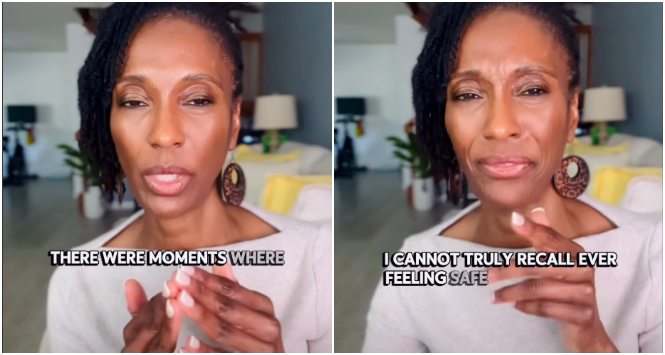
Bernadean, a life-after-divorce coach on Instagram, has opened up about the lingering emotional and physical toll of unhealthy marriages, arguing that healing after divorce is often far more complex than simply ending a relationship.
In a widely shared video posted to her Instagram page, @iambernadean, the coach reflected on the emotional instability she says defined her marriage and explained why many women struggle to feel safe even after finally leaving.
“I cannot truly recall ever feeling safe in my marriage,” Bernadean said in the video. “When you live in that type of inconsistency for years, well, how in the world do you expect to suddenly feel safe and stable even when the marriage ends?”
Her remarks seem consistent with broader discussions among psychologists, trauma specialists, and relationship experts about the long-term physiological effects of chronic emotional stress and unhealthy relationships.
“Your Body Has Got to Feel Safe”
Rather than talking about divorce as an instant path to freedom or happiness, Bernadean stated that many people leave marriages carrying years. sometimes decades of emotional conditioning tied to instability, unpredictability, and stress.
“When you’re coming from a long-term, unhealthy marriage, you’re starting from years and sometimes decades of your body and your mind learning that things are not stable, they’re not safe, they’re not predictable,” she said.
She added that true healing begins with helping the body relearn safety and consistency.
“Your body has got to feel safe. It’s got to know that the chaos is over. You need steadiness and predictability. Then we can start to focus on what’s next because you don’t rebuild your life from confusion,” she stated.
Mental health experts have increasingly pointed to the connection between chronic emotional stress and the nervous system. Therapists specializing in trauma often explain that prolonged exposure to conflict, emotional volatility, manipulation, or instability can leave people in a persistent state of hypervigilance, even after the triggering environment has ended.
Researchers studying trauma responses have also noted that the body can continue reacting as if danger is present long after stressful relationships or situations are over. Symptoms can include anxiety, sleep disturbances, emotional numbness, difficulty trusting others, and an inability to relax.
Divorce Recovery Conversations Evolving Online
Bernadean’s comments reflect a broader shift in online discussions surrounding divorce and emotional healing, particularly among women over 40 and 50 who are increasingly speaking publicly about the mental health aftermath of long-term marriages.
Rather than focusing solely on “moving on” or reentering the dating world, many creators and therapists are discussing nervous system regulation, emotional recovery, self-trust, and rebuilding stability after prolonged emotional strain.
Her message also challenges the often-polished narratives about divorce recovery frequently portrayed on social media, where healing is sometimes framed as immediate empowerment rather than a gradual and emotionally demanding process.
In her caption accompanying the video, Bernadean wrote that many people mistakenly believe peace arrives automatically once divorce papers are signed.
“I thought leaving the marriage would instantly bring peace. My body had other plans,” the caption read.
She added that healing “isn’t about rushing to reinvent yourself,” but instead about creating enough predictability and emotional safety to reconnect with oneself again.
The video has prompted discussions online from women sharing similar experiences of struggling to emotionally decompress after leaving unhealthy relationships, with many describing feelings of lingering anxiety, emotional exhaustion, and difficulty adjusting to calm environments after years of chaos.
Growing Attention to Emotional Health After Divorce
Family therapists and relationship counselors have increasingly stressed the importance of post-divorce emotional recovery, particularly for individuals leaving emotionally abusive or psychologically unstable partnerships.
Experts say recovery often involves rebuilding routines, establishing healthy support systems, developing emotional boundaries, and learning to recognize safety apart from survival mode.
Bernadean’s reflections appear to have struck a chord precisely because they move beyond simplistic narratives of empowerment and instead acknowledge the deeper emotional recalibration many people face after prolonged relational stress.