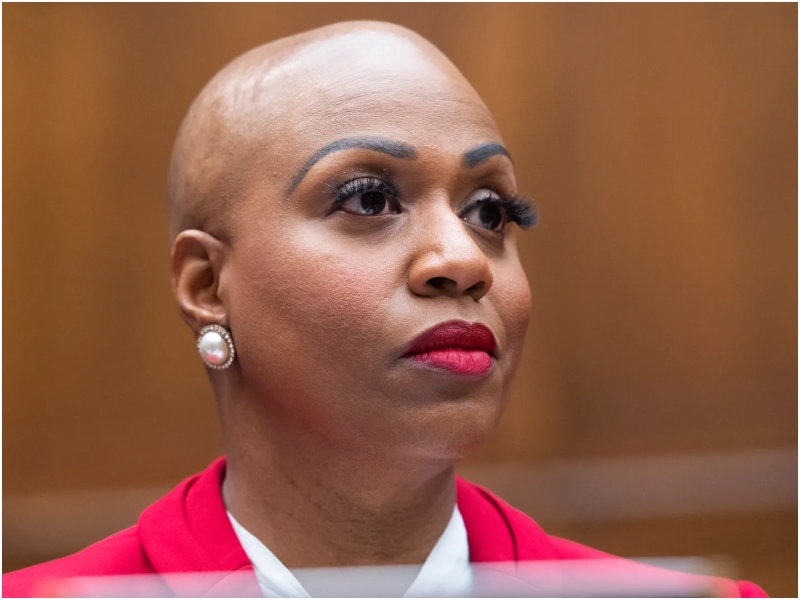
Representative Ayanna Pressley (D-Mass.) has taken a bold legislative step to end qualified immunity for federal law enforcement officers, including Immigration and Customs Enforcement (ICE) agents.
The congresswoman says that the longstanding legal shield has allowed federal agents to evade accountability even after fatal misconduct.
On the House floor this week, Pressley invoked a series of high-profile deaths linked to federal enforcement actions — including the killing of Renee Good, a 37-year-old mother, by an ICE agent in Minneapolis — to make the case for reform.
“Now, the White House is claiming the ICE agents have immunity from lawsuits — enough,” Pressley said, announcing her reintroduction of the bill aimed at eliminating qualified immunity for federal officers.

What the Bill Would Change
Qualified immunity is a doctrine developed by courts that often blocks civil lawsuits against government officials — including law enforcement — unless a plaintiff can show the officer violated “clearly established” law.
Critics argue that this standard makes it nearly impossible for victims of misconduct to obtain redress, even when force or civil rights violations are evident.
Pressley’s bill, introduced with Senator Ed Markey (D-Mass.), is being called the Qualified Immunity Abolition Act of 2026. The measure would explicitly strip federal law enforcement officers, including ICE agents, of qualified immunity in cases involving civil rights violations, allowing survivors and families of victims to pursue lawsuits in federal court without being dismissed on immunity grounds.
Senator Markey said that allowing federal agents to act with impunity has crossed a “dangerous threshold” in the nation, particularly pointing to a series of enforcement operations that have resulted in deaths, detentions and allegations of excessive force.
Context and Momentum
The legislation builds on earlier efforts launched after the killing of George Floyd in 2020 to reform police accountability. Pressley and Markey first introduced similar legislation years ago to challenge qualified immunity at the local and state level; the current effort expands those reforms to federal law enforcement agencies, an area that has drawn increased scrutiny after recent controversial use-of-force incidents.
Pressley referenced not only Good but also other victims, such as Keith Porter, killed by an ICE-affiliated officer in Los Angeles, and Nenko Gantchev, who died in ICE custody after decades in the United States. She said the bill is about ensuring all people in America — citizens and non-citizens alike — can seek justice when agents break the law.
Political and Legal Impact
Legal scholars and civil rights advocates have long criticized qualified immunity as a judicially created doctrine that is not rooted in statute, and that legislation to remove it could restore historical civil rights protections under laws like the Civil Rights Act of 1871. The bill’s supporters argue that removing immunity will enhance accountability, deter misconduct, and restore public confidence in federal law enforcement.
However, the proposal faces steep political challenges. Qualified immunity reform has historically drawn strong opposition from law enforcement organizations and conservative lawmakers, who argue that removing these protections could expose officers to a flood of litigation and hinder effective policing.
Still, Pressley’s move marks a significant escalation in the legislative push for federal accountability and reflects growing tensions over ICE’s use of force.