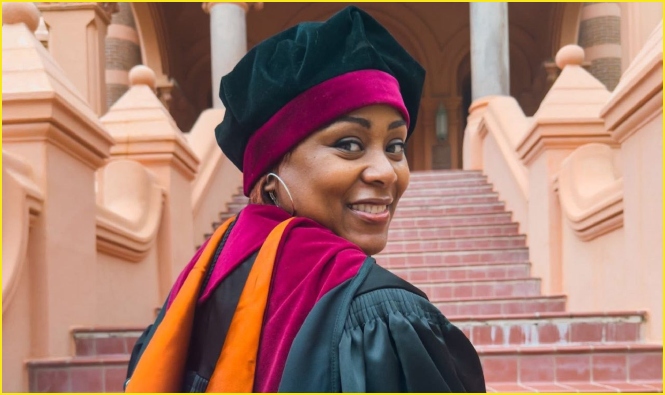
When Dr. RoDina L. Williams reflects on her earliest days at Illinois State University (ISU), she recalls more than a campus—she remembers a community that affirmed her ambitions and sharpened her sense of purpose.
Years later, that foundation has carried her into history: Williams is now the first Black Illinoisan to earn a Doctorate in Clinical Laboratory Science (DCLS), a milestone that speaks not only to her personal determination but to the urgent need for representation in one of healthcare’s most understudied but essential fields.
“It’s where I discovered my passion and love for research,” Williams said in a recent interview with the university. “It’s where mentorship shaped me, and where I gained the confidence to aim higher than I ever imagined.”

Her academic path was never linear. Williams first arrived at ISU as a transfer student drawn to kinesiology, drawn in part by the faculty who saw potential in her before she fully saw it in herself. Professors such as Dr. Pete Smith opened the door to formal research, while Dr. Dale Brown demonstrated how learning becomes powerful when theory connects to lived experience—a philosophy she jokingly admits she “borrowed” for her own classroom.
She eventually returned to ISU to pursue a second bachelor’s degree, this time in medical laboratory science.
“I found the same sense of community and purpose when I returned,” she said. “That constancy said a lot about the type of place ISU is.”
Those years brought more mentors: Dr. Lori Woeste deepened her understanding of the discipline’s many interconnected subspecialties, while longtime mentor Dr. Beverly Barham consistently pushed her to compete for opportunities that stretched her potential.
Reaching the DCLS level—one of the highest professional distinctions in the field—comes with weight. “It means a lot to me to be the first Black person in Illinois to receive a doctorate in clinical laboratory science,” she explained.
But she is careful to ground the achievement in something larger than a single résumé line. In a profession that remains overwhelmingly white, Williams knows visibility matters. “There are still very few Black professionals, and that lack of representation can make it hard for students of color to see themselves in the field.”
Her mission now includes clearing that path for others. She mentors emerging scientists through the Black Colleagues Association and sees representation not as symbolic but as practical—a force that shapes who gets encouraged, who gets supported, and who believes they belong in the lab.
Away from the lecture hall and the laboratory, Williams is also a mother, a daughter, and a woman balancing multiple identities.
“Balance doesn’t always mean everything is perfectly even; it means being present where I am,” she said. Her young son, Kien John, ensures that she remembers the difference between “Dr. Williams” and simply “RoDina.”
Today, she oversees medical laboratory programs at City Colleges of Chicago, where she takes responsibility for educational, clinical, and administrative direction. Asked to summarize the arc of her journey so far, she chose three words: “Challenging, rewarding, honored.”
Her story underscores a broader truth: the future of healthcare, research, and academic leadership depends on who is supported, who is seen, and who is invited in. And for Williams, Illinois State University remains the place that opened that first door.