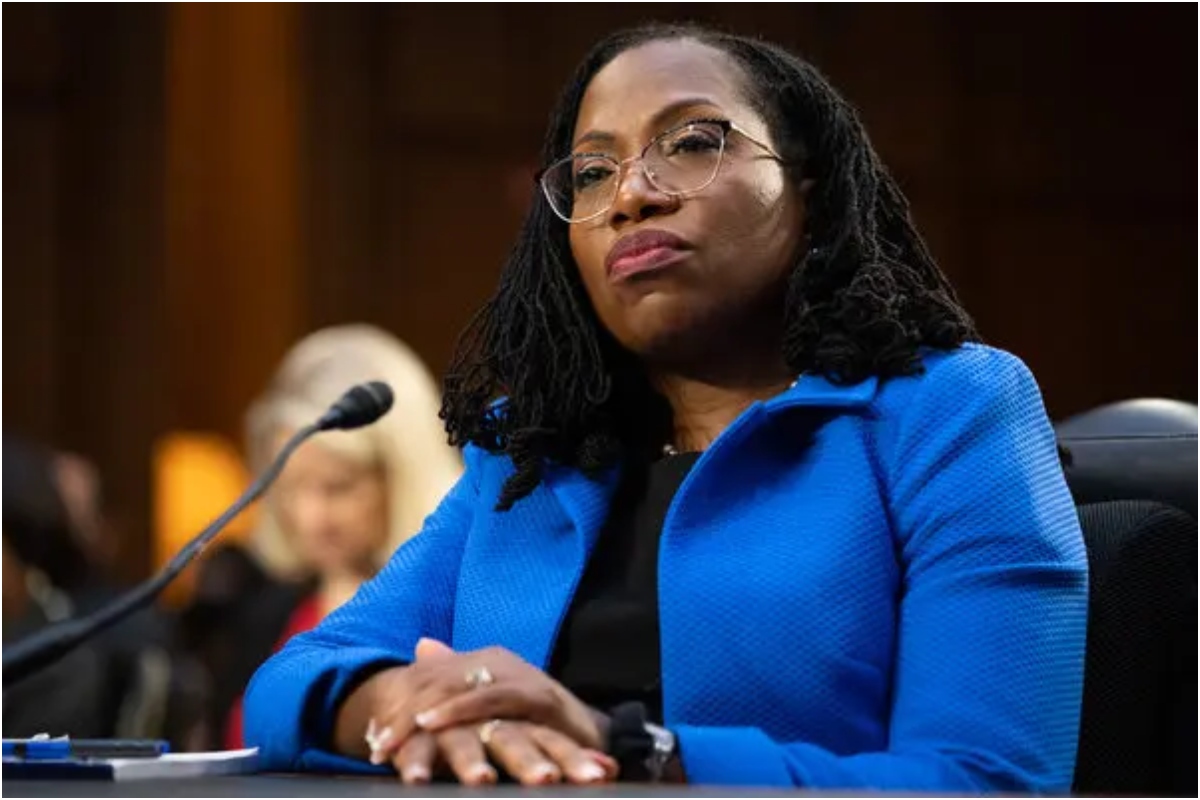
A simmering conflict between two Supreme Court justices burst into public view this week as Justice Ketanji Brown Jackson offered a blistering critique of the Court’s handling of a Louisiana redistricting case.
Justice Jackson’s remarks renew a remarkable back-and-forth with Justice Samuel Alito that exposed deep ideological fissures on the bench.
At issue was the Court’s May 4 decision to fast-track Louisiana’s request to redraw its congressional maps following a blockbuster ruling days earlier that severely weakened the Voting Rights Act.

Louisiana, eager to act before this year’s midterm elections, asked the Court to bypass its usual month-long waiting period. In a one-paragraph order, the Court agreed, with little explanation and no disclosure of the vote. Jackson was the only justice to note her dissent.
Speaking Monday, May 18, 2026, at an American Law Institute event in Washington, Jackson did not hold back.
“Courts are apolitical, not supposed to be issuing rulings that are in the political realm,” she said. “We have to be scrupulous about sticking to the principles and the rules that we apply in every case and not look as though we’re doing something different in this kind of context.”
While Jackson stopped short of accusing her colleagues of partisan motivation, she made clear her concern about perception, especially in an election year when every congressional map matters.
“I think we have to be very constrained,” she said. “My view was it would be a more neutral way to handle the matter to just stick with the rule that we always apply in situations like this.”
Alito’s Scorching Rebuke
The tension between the two justices first erupted in written opinions accompanying the May 4 order. Alito, joined by conservative Justices Clarence Thomas and Neil Gorsuch, launched an unusually personal attack on Jackson’s reasoning.
“What principle has the court violated?” Alito wrote. “The principle that we should never take any action that might unjustifiably be criticized as partisan?”
He went further, dismissing Jackson’s points as “insulting,” “trivial,” and “baseless”, language rarely seen in Supreme Court opinions, where collegiality typically tempers even sharp disagreements.
Jackson’s remarks on Monday largely tracked with her written dissent. Still, her public airing of the conflict, outside the formal confines of a judicial opinion, underscored her determination to frame the issue for a broader audience.
The Emergency Docket Problem
Jackson also used her appearance to criticize the Court’s growing reliance on its “emergency docket,” sometimes called the “shadow docket” by critics, which allows the justices to issue rapid decisions without full briefing or oral argument.
She said the Court was undermining its ordinary process of hearing regular, merits cases by “setting up this other lane of adjudication” on the emergency docket.
“It’s not doing, I think, the court, the lower courts, or our country a service with that kind of procedure,” she said.
What’s at Stake
The underlying legal dispute carries enormous practical consequences. The Court’s late April ruling gutting the Voting Rights Act has already set off a flurry of redistricting across southern states. Civil rights advocates warn that the new maps will reduce the number of Black lawmakers in Congress while giving Republicans a significant advantage in the race for House control.
President Donald Trump, according to a CNN report, is pushing to “eek as much advantage as possible out of redrawn maps” to keep the GOP in control of the House next year.
Jackson, nominated to the Court by President Joe Biden in 2022, has emerged as the liberal wing’s most forceful voice on procedural integrity. Her clash with Alito, a conservative stalwart appointed by President George W. Bush in 2006, reflects a Court that is not only ideologically divided but increasingly willing to let those divisions turn personal.
The Bigger Picture
The Alito-Jackson exchange is more than a personality dispute. It raises fundamental questions about how the Supreme Court manages its own procedures, whether the public can trust its impartiality in politically charged cases, and how long the Court’s internal norms can survive sustained ideological combat.
Jackson’s message Monday was clear: when the Court bends its own rules to act quickly in a political case, it risks looking like just another political actor.
“We have to be really, really careful,” she said.
Whether her colleagues are listening remains an open question.