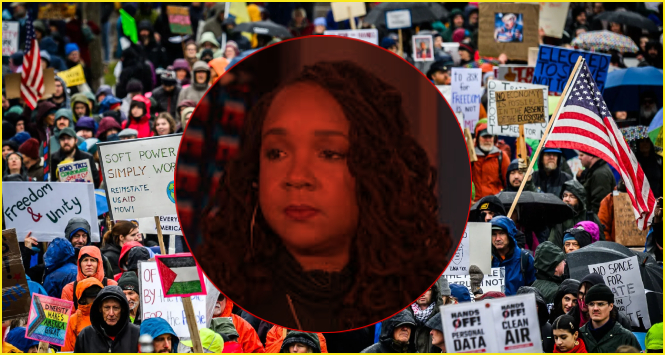
Political commentator Danielle Moodie delivered an emotional and deeply personal reaction to the U.S. Supreme Court’s latest decision impacting the Voting Rights Act.
The podcast host is warning that future generations of Black Americans could grow up with fewer protections than their parents and grandparents fought to secure.
Speaking with independent journalist Chris James in an interview shared on Instagram, Moodie described feeling “tormented” and “hollowed” following the court’s ruling in Louisiana v. Callais, which she believes further weakens protections against racial discrimination in voting and redistricting.
“In 2026, a Black girl or boy that is born today will have less rights than their parents and grandparents,” Moodie said. “If you’re not angry, you’re not paying attention.”

The discussion centered on the Supreme Court’s interpretation of Section 2 of the Voting Rights Act, a key civil rights provision historically used to challenge discriminatory voting maps and election practices.
Moodie argued the decision places a heavier burden on minority communities to prove intentional racial discrimination in redistricting cases.
“So this court decided racism is okay, but we’re going to call it partisanship,” she said. “We’re going to say that it has nothing to do with race, that it has everything to do with partisanship. And what we know is that those two things are inextricably linked.”
But it was Moodie’s reflection on collective complacency that became the emotional centerpiece of the interview.
“I feel like we let our ancestors down,” she said. “I think that we all got too goddamn comfortable and didn’t realize that what they had fought for was not just one and done.”
Fighting back tears, Moodie described waking up devastated by the ruling and uncertain about what comes next for American democracy and civil rights protections.
“I said sorry through tears,” she recalled. “I don’t know what we do now. I don’t know where we go.”
Moodie also connected the current political climate to broader debates surrounding immigration, race, and national identity. Referencing anti-immigration rhetoric from conservative figures, she reflected on how legislative reforms such as the Civil Rights Act, Voting Rights Act, and immigration laws shaped her own family’s story.
“My family was able to come to this country from Jamaica in 1970. My dad wouldn’t have been able to come here from Trinidad,” she said. “They believe that you and I, our families, are a stain on this country.”
Despite her frustration, Moodie ended the conversation by calling on Americans to imagine a more inclusive and equitable future.
“You’re telling me with everything that we know now, we can’t create something better?” she asked. “We can. We just have to create the space in order to imagine it.”
The interview has resonated widely online, particularly among Black voters and civil rights advocates concerned about the erosion of federal voting protections and the long-term impact of Supreme Court rulings on marginalized communities.