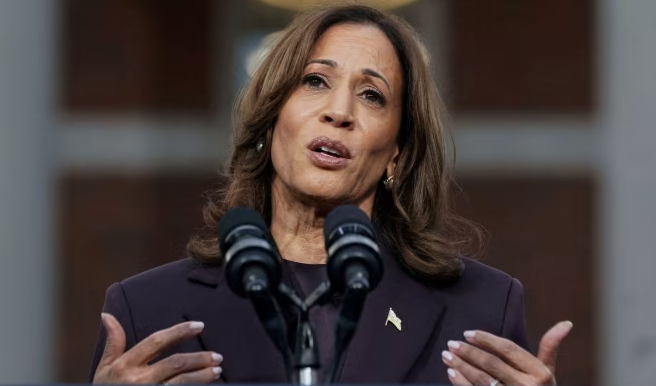
In a deeply critical interview on MSNBC’s The Weekend, former Vice President Kamala Harris laid bare her concerns about the current state of the U.S. Justice Department, accusing President Donald Trump of weaponizing it against his political opponents and undermining institutional safeguards.
The conversation also ranged across militarized deployments in cities, the limits of presidential power, and Harris’s newly published memoir, 107 Days.
“I don’t know if we can trust what’s coming out of the Department of Justice right now,” Harris told host Eugene Daniels.
A Vengeance Campaign, According to Harris
Harris characterized Trump’s recent indictments of high-profile figures — including former FBI Director James Comey and New York Attorney General Letitia James — not as efforts for justice, but as politically motivated retaliations. She said these legal actions are part of a “vengeance campaign” designed to chill dissent and punish former critics.
“One of the things we talked about during those 107 days … was that this is a full-on frontal attack on the rule of law in our country,” she said.
She argues Trump treats the Department of Justice as his personal legal engine, directing prosecutorial outcomes based on loyalty instead of evidence.
When Daniels pressed whether ordinary Americans could trust DOJ’s output, she replied, “I don’t know if we can”—noting she had once built her career as a prosecutor committed to blind, principle-driven justice.
Harris also praised lower court judges—some appointed by Trump—as a resilient bulwark. She said they have, in several cases, stood firm against apparent overreach by the executive branch.
“Where there is an abuse of power, they’re going to stand firm,” she told Daniels.
Militarizing American Streets
Another flashpoint in the interview was Trump’s controversial deployment of the National Guard and military assets in U.S. cities such as Chicago. Harris drew a stark comparison: Black Hawk helicopters poised over American neighborhoods, she said, are symbols of war, not law enforcement.
“A military that has been set up … to fight adversaries, fight enemies — being deployed on the streets of America as though we are the enemy,” she said.
Invoking the 2020 Supreme Court decision that granted sitting presidents de facto immunity for in-office conduct, Harris said Trump entered the 2024 race already shielded from accountability. That decision, she argued, created a legal vacuum allowing him to project power unchecked.
Holding the Line from Within
When asked about civil servants who feel worn down under pressure — particularly within DOJ and other federal agencies — Harris did not issue a blanket mandate. But she encouraged those with the resilience to stay and uphold their ethical duties, insisting that institutional memory and principled actors are essential to any recovery of trust.
“If they can stay and stick with it, I would implore them to do it for the sake of the country,” she said.
She also underscored that no president should ever treat DOJ as a personal attorney, or shape prosecutorial decisions based on personal vendettas.
“107 Days” & the Stakes Ahead
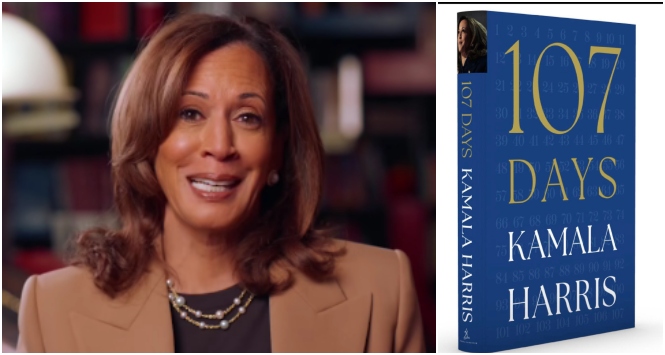
Harris’s memoir, 107 Days, recounts her short-lived 2024 presidential campaign — initiated only after Joe Biden abruptly exited the race. The title references the total days she campaigned. In her interview, she framed the book not just as a political retrospective but a warning: systems can bend, but they must not break.
She also addressed whether the Democratic Party should adopt more assertive strategies in the next presidential term. Her answer: even while fighting, any future president must resist using DOJ for personal or partisan ends.
On foreign policy, Harris declined to offer strong praise for recent Israeli-Palestinian ceasefire efforts, saying they should be judged on real impact—not mere headlines. She emphasized listening to communities, rebuilding trust, and restoring a government worthy of the public’s highest aspirations.
Perspective & Significance
Harris’s critique captures a broader anxiety that many in American civic life now feel: that constitutional norms meant to insulate institutions from politics are fraying under pressure. Her positioning as both a former high-ranking official and a woman of color amplifies the stakes — she speaks from within and without, bearing both institutional memory and marginalized perspective.
Her warnings are not just partisan barbs, but constitutional alarms: once citizens lose faith that justice is blind, the foundations of democratic government weaken.
Whether one agrees with her politics or not, the conversation underscores a central tension of modern governance: Can power be reined in by rules, or do rules ultimately bow to power?