A resurfaced video featuring a Black woman warning against the use of Indian human hair extensions has gone viral on social media.
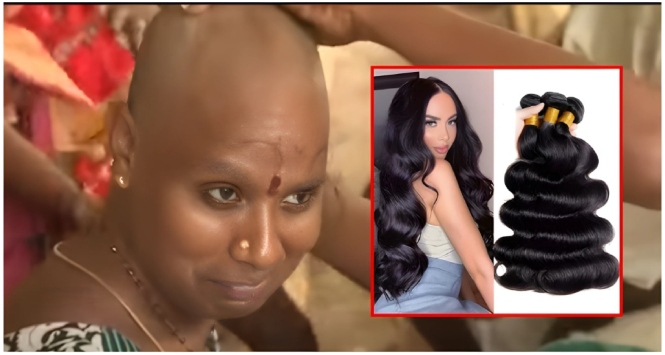
In the video, which appears to be several years old but recently gained traction online, the unidentified speaker claims that Indian hair—commonly used in weaves and wigs—is harvested through a religious ritual meant to symbolically rid individuals of misfortune. According to her, Black women who wear this hair may unknowingly be carrying spiritual “bad luck.”
“There is no group of people that hate themselves like Black people,” the woman says in the video. “Why do you put on Indian human hair? … [Hindus] incantate all the bad luck they are facing onto the hair … and then they shave their head. You buy your own bad luck and you put it on your head.”

Her remarks have reignited longstanding conversations about the origins of hair sold in the global extensions market, particularly hair sourced from temples in India.
Ritual or Resource? The Roots of Indian Hair Sales
The woman’s claim references a Hindu ritual known as Tonsure—a tradition in which devotees shave their heads in temples as an offering to the gods in exchange for spiritual blessings or the alleviation of suffering.
This practice was the focus of a 2017 BBC investigation by journalist Justine Lang, who visited a temple and hair processing facility in India. In her report, an indian woman explained in Hindi:
“My husband is drinking and my children are doing badly in their studies. I want these problems to be overcome. I have prayed to the gods and have decided to shave my hair.”
Lang’s report also introduced Benjamin Cherian, founder of Raj Hair International Pvt. Ltd., one of the companies that exports temple hair globally, including to African countries.
“I have seen my future is in Africa,” Cherian said. “I see the eyes gleaming with happiness … because they think their beauty is enhanced by wearing this hair phenomenally.”
Cultural Reverence or Commercial Exploitation?
Temple hair is often regarded as a sacred gift, not only by those who offer it but also by the temples that sell it to fund charitable projects. However, critics argue that the commercialization of this religious practice, combined with its massive demand in Black beauty markets across Africa, the U.S., and Europe, raises ethical concerns.
For some, the speaker in the viral video offers a spiritual and cultural critique. For others, her tone and message border on shaming Black women who choose to wear weaves, particularly when options for embracing natural textures are not always viable or accepted in professional and social settings.
Online Reactions
The video has ignited a mix of praise and pushback online. Some viewers said they had never heard of the Tonsure ritual and felt misled about the hair they were purchasing. Others felt the speaker’s message veered into judgment and lacked empathy for the social pressures Black women face when it comes to appearance.
“Listen girls to a grand mother with words of wisdom and maybe one day you’re become a smart woman,” one person said on Instagram.
Another added:
“The video made me rethink where I get my hair from. I don’t want something sacred turned into a fashion statement.”
While the spiritual implications of wearing Indian hair remain a matter of personal belief, the video has brought renewed attention to how cultural rituals intersect with global beauty standards, economic power dynamics, and identity.
For many Black women, it’s a complex web of personal choice, cultural symbolism, and self-expression.