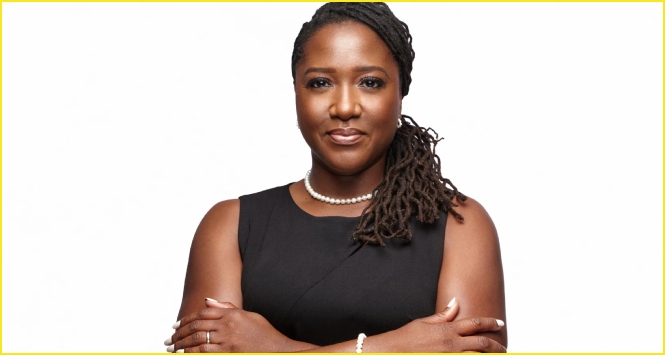
Civil rights attorney Janai Nelson, president and director-counsel of the NAACP Legal Defense and Educational Fund (LDF), made history this week as she stood before the U.S. Supreme Court to defend the Voting Rights Act of 1965 — one of the nation’s most significant civil rights protections.
On Wednesday, Oct. 15, 2025, Nelson argued her first case before the high court in Louisiana v. Callais, a pivotal voting rights case that could determine the future of racial equity in America’s electoral system.
At the center of the case is whether Louisiana should create a second majority-Black congressional district, often referred to as an “opportunity district” under Section 2 of the Voting Rights Act (VRA).
Nelson’s arguments sought to uphold decades of precedent protecting Black voters from discrimination in the political process.
Section 2 of the VRA prohibits any law or policy that results in the “denial or abridgement of the right of any citizen… to vote on account of race or color.”
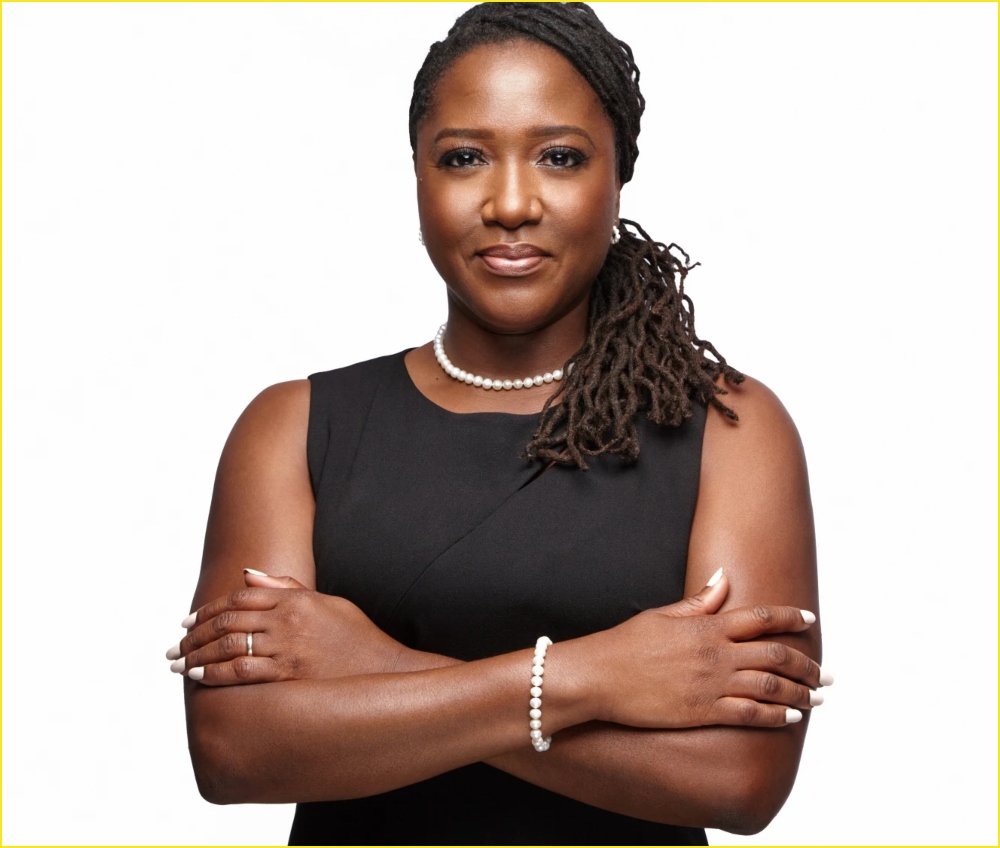
Representing Black voters, Nelson told the nine justices that race — not politics — remains the defining factor in Louisiana’s voting patterns:
“We know that there is such a significant chasm between how Black and white voters vote in Louisiana that even if there is some correlation between race and party, race is the driving factor.”
Attorneys for the state of Louisiana, a group of white voters, and the U.S. government argued that the creation of an additional majority-Black district constitutes racial discrimination against white voters and is politically motivated. Nelson countered that the argument disregards the long, documented history of racial gerrymandering and voter suppression in Louisiana.
A Landmark Moment for a Civil Rights Veteran
For Nelson, a graduate of UCLA School of Law and a Fulbright Scholar, the appearance marked a defining moment in a career devoted to advancing racial justice and voting rights.
“This case isn’t just about Louisiana — it’s about the soul of American democracy,” Nelson said in an interview with Joy Reid. “We shouldn’t have to make this argument, but I’m honored to carry forward the mantle of those who came before me and challenged this court to live up to its highest ideals.”
Her appearance continues the legacy of Thurgood Marshall, who founded the LDF in 1940 and became the first Black U.S. Supreme Court Justice. Nelson now leads the very organization that once dismantled Jim Crow segregation through landmark victories like Brown v. Board of Education (1954).
A Trailblazer in Law and Academia
Before becoming LDF’s president, Nelson built an illustrious career as a scholar and advocate. She previously served as Associate Dean for Faculty Scholarship and Associate Director of the Ronald H. Brown Center for Civil Rights and Economic Development at St. John’s University School of Law, where she taught courses in election law, constitutional law, and racial equity strategies.
She has written extensively on voting rights and democratic theory, including her influential article “Parsing Partisanship: An Approach to Partisan Gerrymandering and Race,” published in the NYU Law Review.
Nelson’s work has taken her across continents — from litigating voting rights cases in the U.S. to conducting Fulbright research in Accra, Ghana, where she examined the political disenfranchisement of people with criminal convictions.
Decades Defending the Right to Vote
Nelson’s legal record includes several landmark cases. As Assistant Counsel at LDF, she helped lead challenges against voter suppression and felony disenfranchisement laws, including Hayden v. Pataki in New York and NAACP v. Hood in Florida following the 2000 presidential election.
More recently, she served as counsel in Veasey v. Abbott (2018), where LDF successfully challenged Texas’s discriminatory voter ID law, and in National Urban League v. Trump (2020), where she fought to overturn the Trump administration’s ban on diversity and inclusion training — a measure later rescinded by President Biden.
Nelson also represented journalist Nikole Hannah-Jones in her high-profile tenure dispute with the University of North Carolina, helping spark national debate over race and academic freedom.
The Stakes: The Future of the Voting Rights Act
The Voting Rights Act, first signed into law in 1965 by President Lyndon B. Johnson, was hailed as one of the “greatest achievements in the history of American freedom.” But in recent years, a series of Supreme Court rulings — including Shelby County v. Holder (2013) and Brnovich v. DNC (2021) — have weakened key provisions of the law.
The Louisiana v. Callais decision, expected in summer 2026, could further redefine the scope of Section 2 — and by extension, the power of minority voters nationwide.
“I hope we get a 9-0 vote in our favor,” Nelson said. “The law compels that. But we only need five — and we’ll take whatever it takes to preserve the Voting Rights Act.”
Nelson underscored that her argument is about more than party politics or regional boundaries.
“This is about American freedom,” she said. “It’s about ensuring we have a robust democracy that fulfills our constitutional promise.”
Carrying the Torch of Justice
As the courtroom doors closed after her first Supreme Court argument, Nelson joined a lineage of civil rights lawyers who dared to confront the highest court in the land on behalf of those whose voices are too often silenced.
Win or lose, her appearance marked a historic moment for Black women in law and a reminder that the fight for voting rights — one that began with the Selma marches and the passage of the VRA — continues to this day.