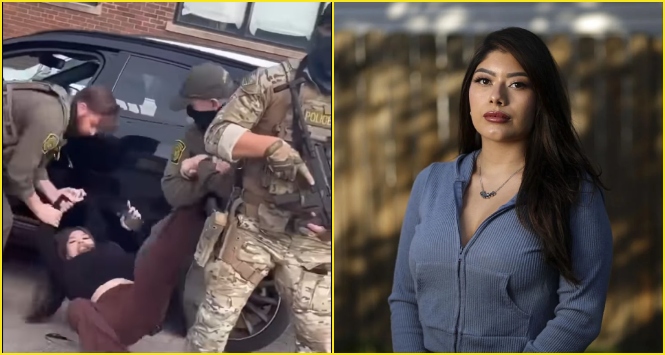
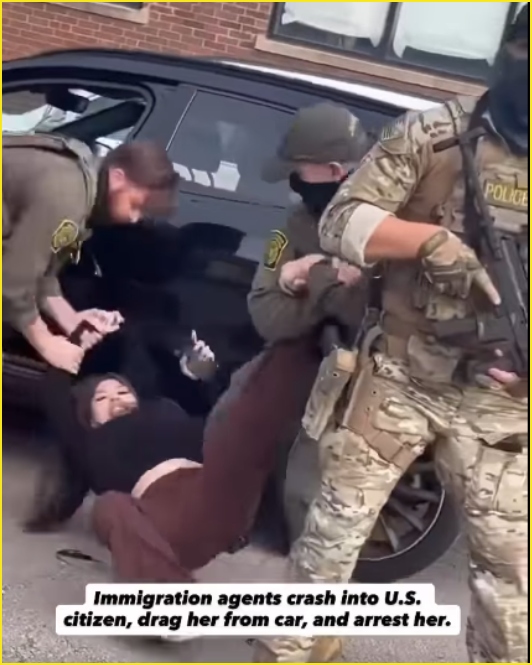
A routine morning drive in Chicago turned into a nightmare for Dayanne Figueroa, a U.S. citizen, after Immigration and Customs Enforcement (ICE) agents reportedly dragged her from her car at gunpoint following a traffic collision with an unmarked government vehicle.
A now-viral video of the incident, captured by a bystander and shared widely on social media, shows the chaotic scene: armed ICE agents jumping out of a white minivan, guns drawn, shouting orders as they approach Figueroa’s car. Seconds later, they force open her door, pull her out by her legs, and pin her to the ground.
The footage has sparked widespread outrage, raising new questions about ICE’s use of force and lack of identification during encounters with civilians — particularly in urban areas like Chicago that have long resisted federal immigration crackdowns.
‘They Hit Her First’
Witnesses at the scene insist that Figueroa’s car was sideswiped by the unmarked government vehicle before the confrontation began.
“You hit her! We have it on video!” one bystander can be heard yelling as agents pull her away.
“They never said who they were or why they were taking her,” said Daniel Hogan, who recorded the encounter. “She wasn’t resisting — she was terrified. They came at her with guns drawn.”
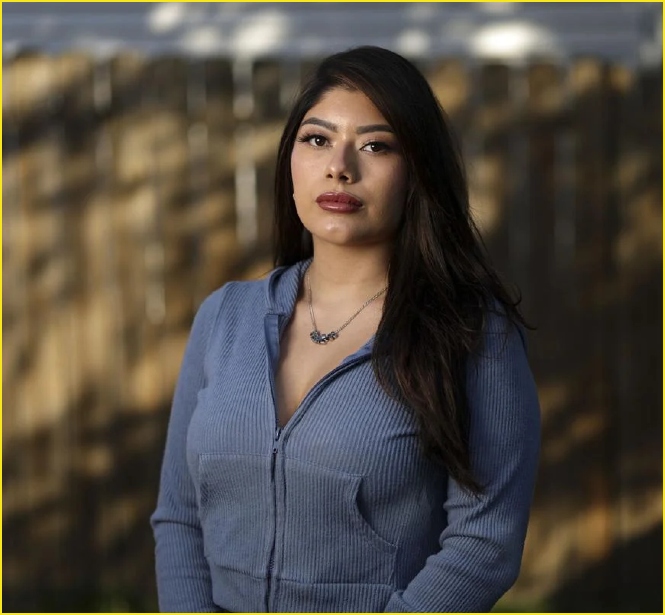
Figueroa, who works as a paralegal and is studying to become a lawyer, said she was “in shock and terrified.”
“The video evidence is clear: Agents crashed into me,” she told the Chicago Tribune. “I was not involved in any protest or related activity. I intend to seek justice for how I was treated.”
Detained, Moved, and Denied Contact
According to Figueroa, after being detained, agents took her to multiple undisclosed locations and denied her access to legal counsel or family contact for several hours. Her family only located her after tracking her iPhone signal to the ICE processing center in Broadview, Illinois.
Her mother, Teresita Figueroa, described the ordeal as “agonizing.”
“I was desperately worried because I know ICE agents can be reckless,” she said. “They had just killed a man in Franklin Park. I feared they would hurt my daughter.”
Teresita noted her daughter had recently undergone kidney surgery, making the force used against her especially dangerous.
Figueroa was released from custody later that afternoon, bruised and in shock. Her mother met her at an ambulance near Lombard and took her straight to the hospital.
ICE and DHS Respond — and Blame Figueroa
The Department of Homeland Security (DHS) defended the agents’ actions, claiming Figueroa “crashed into an unmarked government vehicle and violently resisted arrest, injuring two officers.”
Assistant Secretary Tricia McLaughlin went further, labeling Figueroa an “agitator.” In a statement, she said:
“She used her vehicle to block in agents, honking her horn. When officers attempted to remove her, she violently resisted, kicking two agents and causing injuries. This agitator was arrested for assault on a federal agent.”
Civil rights attorneys say the government’s explanation conflicts sharply with eyewitness video and multiple accounts at the scene.
Calls for Accountability
The incident adds to a growing list of complaints about ICE’s aggressive and opaque enforcement tactics in Chicago. The agency has been under scrutiny for targeting civilians, journalists, and bystanders who film operations — even in neighborhoods with no active immigration raids.
Earlier this month, a WGN producer was detained for seven hours after filming a similar ICE operation in Lincoln Square. Federal judges have also questioned ICE officials over potential violations of court orders restricting the use of force and intimidation tactics in Illinois.
Civil rights advocates are demanding a full federal investigation into Figueroa’s arrest, calling it a “dangerous escalation” of enforcement activity that undermines public trust.
“This is not law enforcement — this is intimidation,” said one Chicago-based immigration lawyer. “When a U.S. citizen can be pulled from her car by unidentified agents and disappeared for hours, we all have reason to be afraid.”
A City on Edge
For many Chicagoans, the video of Figueroa’s arrest is more than an isolated incident — it’s another chapter in the city’s long struggle with federal overreach and police accountability.
The images of armed agents surrounding a young Latina woman, her car door ripped open, coffee cup still in the holder, keys still in the ignition, have become a symbol of a deeper problem: a system that too often treats ordinary people as suspects first and citizens second.
Figueroa has since launched a legal fund to cover her medical and legal expenses, vowing to fight back.
“I’m lucky to be alive,” she said quietly. “But no one should have to feel lucky just to survive an encounter with law enforcement.”