
Media commentator and political activist Danielle Moodie has issued a blistering critique of U.S. political leadership and law enforcement.
The outspoken commentator says recent revelations tied to the Jeffrey Epstein case and ongoing government actions have left her feeling “just unbelievable sadness” for victims and deeply alarmed about the state of the country.
In a widely shared Instagram video posted under her handle @deetwocents, Moodie said the United States is experiencing a moral reckoning, driven by what she described as systemic cruelty, impunity for powerful figures, and a failure to protect vulnerable people—especially children.
“I think we’re having a reckoning as a society,” Moodie said, adding that no child should ever be subjected to abuse or exploitation of the kind associated with Epstein.
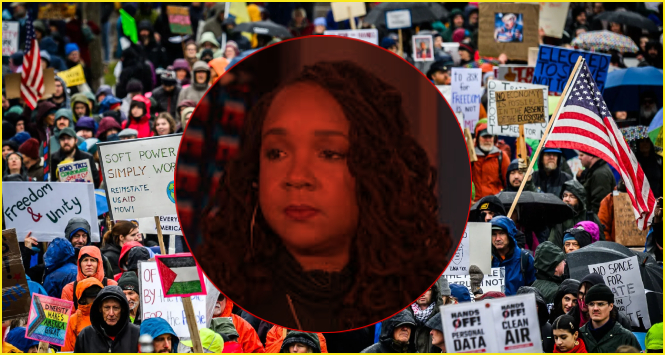
She explained that her dominant emotional response to recent news coverage was not shock or anger alone, but profound sadness for victims whose suffering, she believes, has not been adequately confronted.
Moodie connected her remarks to renewed public attention on Epstein-related documents that have circulated online and in media commentary. She argued that references to powerful political figures in those materials—particularly former President Donald Trump—raise serious questions that, in her view, remain unanswered.
While acknowledging that not all mentions in such documents constitute criminal behavior, Moodie criticized public officials and commentators who have minimized social or professional associations with Epstein. She pointed to statements suggesting that “partying” or exchanging emails with Epstein was not a crime, calling that framing morally inadequate given Epstein’s conviction and the scale of abuse allegations against him.
“What are we doing here?” she asked in the video, questioning why there has not been broader accountability or more aggressive investigations in response to the case’s renewed visibility.
Beyond the Epstein files, Moodie expanded her critique to U.S. immigration enforcement and policing. She condemned the detention of migrant children, the use of force by Immigration and Customs Enforcement (ICE), and what she described as selective outrage when victims of state violence are not U.S. citizens.
“Our humanity doesn’t stop at who has a blue passport,” she said, arguing that law enforcement agencies should not kill anyone, regardless of citizenship or immigration status.
Moodie also expressed frustration with what she sees as gaps in mainstream media coverage, suggesting that violence against non-citizens and allegations involving powerful figures do not receive the same sustained scrutiny as other cases. She speculated that the public may only be seeing a fraction of what authorities know about Epstein and related networks, though she did not present new evidence to support those claims.
Her comments quickly sparked debate online. Supporters praised Moodie for articulating widespread anger and grief over child exploitation scandals, immigration policy, and perceived political impunity. Critics, however, accused her of using inflammatory language and blurring the line between documented facts and personal opinion.
Legal analysts caution that the presence of names in Epstein-related documents does not, on its own, establish wrongdoing, and stress the importance of distinguishing allegations from proven conduct. Even so, Epstein’s crimes and the failures that allowed them to continue remain a subject of ongoing public and legal scrutiny.
Moodie’s remarks highlight a broader crisis of trust in institutions, as social media increasingly becomes a forum for emotional, values-driven responses to complex legal and political issues.
Speaking with grief rather than detachment, her message underscores how the Epstein case continues to resonate—not just as a legal scandal, but as a symbol of deeper fears about power, accountability, and whose lives are protected.


