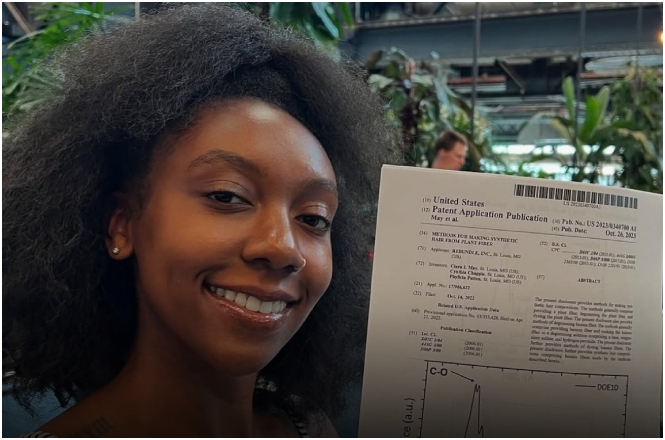
Two years after launching her innovative company Rebundle, Ciara Imani May has achieved a historic milestone: securing a U.S. patent for braidbetter, the nation’s first plant-based braiding hair.
May, who grew up in Kansas City, Mo., as the daughter of a hairdresser, founded Rebundle in 2019 with the mission of addressing both the health and environmental harms caused by synthetic braiding hair.
Conventional extensions, widely sold in beauty supply stores, are typically made from plastic, single-use, and not recyclable. Many consumers also report scalp irritation and inflammation from toxic chemicals in these products.
With braidbetter, May created a line of biodegradable extensions made with banana fibers sourced from Africa. These extensions are reusable up to three times, compostable, and designed to protect scalp health without disturbing its microbiome.
“The patent protects the core innovation behind braidbetter, giving it its unique texture, durability, and scalp comfort,” May said. “For our community, it’s further proof this product is protected, scalable, and here to stay.”
Health and legal context
The patent approval comes at a time when the Black haircare industry is under scrutiny. In 2023, Consumer Reports released a study showing cancer-causing chemicals and heavy metals—including lead—in popular synthetic braiding hair brands.
This follows thousands of lawsuits filed in federal court against chemical relaxer manufacturers after a 2022 National Institute of Health study linked relaxer use to higher rates of uterine cancer among Black women.
May says these studies validate what many in the community have long known: the beauty industry often profits from harmful products disproportionately marketed to Black women.
“It’s not our responsibility to produce a study on what’s in other people’s products. That’s for researchers and safety advocates,” she said. “We’re glad there’s finally outside perspective on this widely used product.”
Building global ties and legal protection
To source eco-friendly fibers, May began building relationships with African suppliers through platforms like WhatsApp before visiting Uganda in 2021 to strengthen partnerships. She credits those connections with helping Rebundle refine its product and scale production.
Getting a patent was always part of her vision. Working with intellectual property lawyers and taking advantage of pro bono university legal aid, May filed Rebundle as a micro entity, which reduced fees and allowed her to protect her innovation.
“I wouldn’t describe this process as challenging—it just takes time,” May explained. “Having good lawyers was the key. I encourage other entrepreneurs to seek out free legal resources through local universities.”
Expanding Rebundle’s reach
Rebundle has already built a directory of nearly 400 hairstylists across the U.S. and U.K. who use braidbetter. The company is also preparing to expand sales into retail hair stores and screen its documentary Reclaimed, which highlights the brand’s story and the broader cultural movement to reclaim the Black haircare industry.
Along with extensions, Rebundle produces scalp-safe gels and mousses. The company is committed to sustainability, previously recycling almost 1,000 pounds of synthetic braiding hair before pausing to find a more collaborative recycling partner.
For May, the patent is more than legal protection—it’s a step toward reshaping an industry.
“Being a Black woman entrepreneur in haircare means being both a builder and an advocate,” she said. “I often feel like an activist in the way I approach my work. This legacy will leave our community more empowered.”