
Television veteran Whoopi Goldberg reminded viewers why live TV remains unpredictable when she clashed openly with producers of The View during a heated discussion about President Donald Trump.
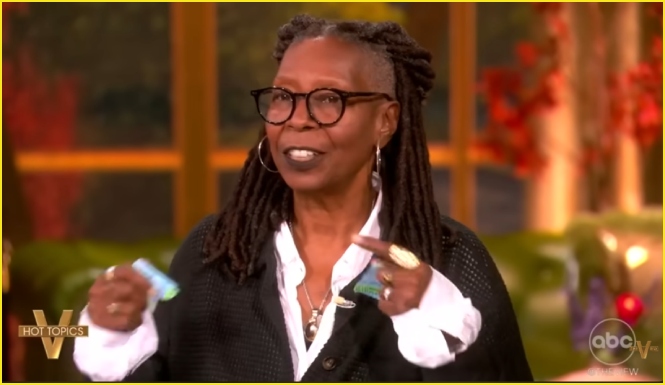
She ripped up a note passed quietly to her live on-air.
The 69-year-old EGOT winner’s frustration boiled over during a recent episode of the long-running ABC talk show, as the panel dove into Trump’s latest controversy (his denial of knowing Binance founder Changpeng “CZ” Zhao) despite having personally pardoned him during his presidency.
As co-host Sunny Hostin, 57, detailed how the Trump family allegedly profited from their time in office, she questioned how the controversial U.S. president could possibly forget the crypto billionaire. Goldberg fired back with a tongue-in-cheek quip:
“Because he used an autopen.”
The joke referenced Trump’s own jabs at former President Joe Biden, whom he has repeatedly accused of using an autopen to sign documents — a taunt meant to question Biden’s competence.
Trump once even replaced Biden’s portrait in the White House’s “Presidential Walk of Fame” with an image of an autopen signature.
But producers of The View didn’t find Goldberg’s wisecrack funny. Moments later, Hostin slipped Goldberg a blue cue card handed down from the control room.
“What the hell? What?” Goldberg exclaimed, visibly irritated, before reading the producer’s note aloud:
“We don’t know if Trump used an autopen to pardon.”
Goldberg’s patience snapped. She tore the note in half on live television and shouted:
“It was a joke! The hardest thing about this job now is that no one understands nuance.”
The Emmy-winning host continued, gesturing toward the audience and her co-hosts:
“You know when you hear a joke, when somebody is fooling around, when they’re not saying something specific. Especially on this show! I’m very specific when I’m pointing stuff out. When I’m making jokes, you know I’m making jokes. This is ridiculous.”
The moment has since gone viral.
Supporters hailed Goldberg’s candor as a rare defense of comic authenticity in an age of corporate caution.
“Tear it up, Whoopi,” one YouTube viewer wrote. “She said what we all feel — enough with overcorrection,” another added.
But others accused Goldberg of losing her cool and crossing professional lines.
One critic fumed, “The next note should be: you’re fired.” Another commenter claimed, “They are afraid of being sued. That’s why she read that. The View is way overdue to be canceled.”
The confrontation underscores a growing tension between outspoken hosts and risk-averse networks wary of live controversies in a polarized political climate.
Goldberg’s latest dust-up adds another chapter to her long, turbulent relationship with Donald Trump, a feud stretching back more than a decade. Their public sparring began in 2011, when Goldberg grilled Trump on The View over his promotion of the racist “birther” conspiracy against then-President Barack Obama.
Since then, the two New Yorkers have traded verbal blows through interviews, campaign rallies, and even musical cues. When Trump in 2024 called Goldberg’s comedy “filthy, dirty, disgusting,” The View fired back by entering to Christina Aguilera’s “Dirrty.”
Most recently, Donald Trump reignited the feud, urging ABC to release footage he claims shows Goldberg cursing at a live audience during a 2019 taping — a claim insiders have dismissed as “not ringing true.”
Goldberg’s blow-up this week may not have changed any political minds, but it perfectly captured what The View has long been: an unfiltered space where humor, frustration, and politics collide — often spectacularly.
Whoopi’s on-air outburst may read as a diva moment, but beneath it lies something deeper, the exhaustion of speaking freely in a time when every joke risks corporate reprimand. Her frustration wasn’t just about Trump or a blue cue card; it was a reminder that in modern media, truth and humor are increasingly policed in real time.
When Goldberg tore up that note, she wasn’t just defying her producers, but she was, in her own fiery way, defending the dying art of saying what you actually think.


