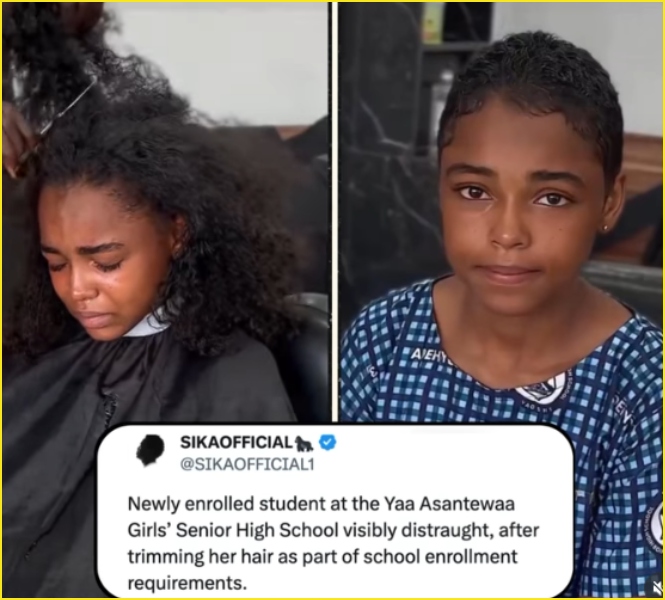
A tearful video of a first-year senior high school student in Ghana being forced to cut her beautiful curly loc has set the country ablaze—digitally and emotionally.
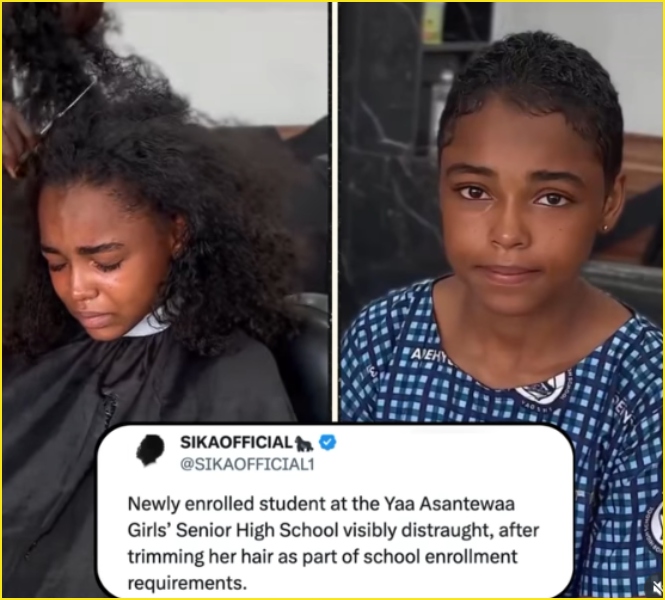
The 30-second clip, shared on TikTok and X around Oct. 21, shows the young girl sobbing uncontrollably as her long hair was cut short at a salon to shave off her long locs.
The scene, reportedly captured during the Yaa Asantewaa Girls’ Senior High School (YAGSHS)’s enrollment week, has since been viewed millions of times, sparking anger, empathy, and renewed scrutiny of Ghana’s school hair policies.
The Incident
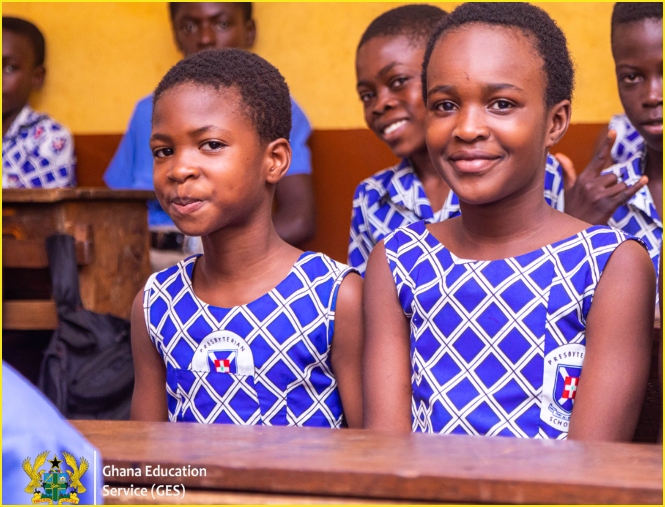
The unnamed student had just been placed at YAGSHS through Ghana’s Computerized School Selection and Placement System (CSSPS). Excited to begin her secondary education, she arrived on campus with long, curly hair—a hairstyle she had proudly maintained. But YAGSHS, like most public senior high schools in Ghana, enforces a decades-old rule: all female students must keep their hair short, typically no longer than two inches.
What followed was devastating. Teachers reportedly insisted she visit a nearby salon before completing her admission process. The viral video shows the child’s hair being trimmed while she weeps.
Many Ghanaians have described the video as “heartbreaking” and “dehumanizing,” with others likening it to a forced conformity that strips young girls of cultural pride.
The School’s Defense
While YAGSHS has yet to issue a direct statement, the Ghana Education Service (GES), which governs Basic Education, Senior High Education, Technical Education and Special Education in Ghana, maintains that short-hair policies promote discipline, hygiene, and uniformity. Officials argue that such grooming standards minimize distractions and make boarding life more manageable in schools with limited resources.
However, critics, who comprise a growing number of ordinary Ghanaians both at home and abroad, say these justifications echo colonial-era ideology, designed to suppress African aesthetics under the guise of neatness.
“These rules were crafted to erase identity, not enhance education,” said a social commentator. “They’re relics of an outdated system that prized compliance over confidence.”
A Debate Reignited
The incident has drawn immediate comparisons to the 2021 Achimota School case, where two Rastafarian students — Tyrone Marhguy and Oheneba Nkrabea — won a landmark Supreme Court ruling allowing them to wear their locs. That victory was celebrated as a milestone for religious and cultural freedom. But this new case, some say, exposes how little has changed in practice.
On social media, outrage has been swift and unrelenting.
- The hashtag #LetGirlsGrowHair has surpassed 50,000 posts since October 22.
- Musician Adomaa called the ordeal “unnecessary trauma” and a “colonial punishment.”
- Activist @SIKAOFFICIAL1, who was among those to first shared the video, wrote: “We tell Black girls to love their hair, then force them to shave it in school. Make it make sense.”
In contrast, a smaller but vocal group of defenders—including some alumni—insist the rule is necessary to maintain equality and discipline.
“It’s not about hate or control,” one YAGSHS alumna wrote on Reddit’s r/Ghana thread. “It’s about focus.”
Beyond the Hair: A Cultural Reckoning
The debate now transcends grooming. The long-standing debate is really about autonomy, identity, and decolonization. For many Ghanaians, the YAGSHS video reflects how colonial-era institutional rules still regulate Black femininity through Eurocentric ideals of neatness. Scholars and activists argue it also reflects broader societal discomfort with natural hair and self-expression.
In a world increasingly embracing natural hair movements, fueled by legislation like the U.S. CROWN Act, Ghana’s archaic grooming policies appear frozen in time.
Even some educators admit it’s time for change. Emmanuel Antwi and Ginn Bonsu Assibey, both affiliated with the Kwame Nkrumah University of Science and Technology (KNUST), believe schools should promote Afro-centric hairstyles.
In their 2024 paper “Afro-Identity Redemption: Decolonizing Hairstyles of Girls in Ghanaian Senior High Schools in Promotion of Cultural Sustainability”, they explicitly call for schools to permit Afro-centric natural hairstyles, including long hair, locs, and braids.
Their academic research paper argues that the mandatory short-cut policy, rooted in colonial “neatness” standards, disrupts cultural sustainability and burdens girls with “cumbersome” maintenance excuses that ignore the empowering skills of natural hair care.
“To train the girl-child wholly for life, they should be allowed to explore Afro-defined natural hairstyles to develop the skills of maintaining their cultural image,” the researchers write.
The young girl’s family has not spoken publicly on the matter.