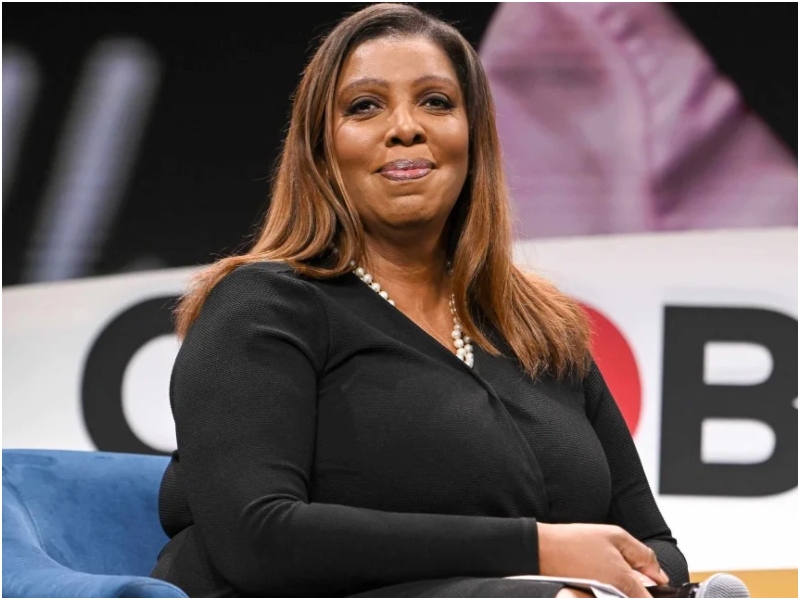
New York Attorney General Letitia James on Monday, Nov. 24, scored a sweeping legal victory after a federal judge dismissed the criminal case against her.
The court ruled that the Trump administration’s handpicked prosecutor, who pursued the indictment, had been unlawfully installed.
In a sharply worded order, Judge Cameron McGowan Currie ruled that the appointment of Lindsey Halligan as interim U.S. Attorney for the Eastern District of Virginia — a role from which she brought charges against James and former FBI Director James Comey — was “invalid,” and that every action flowing from that appointment must be set aside.
The ruling immediately voided the indictment that alleged James falsely claimed a second home to secure a better mortgage rate — a charge she has vehemently denied.
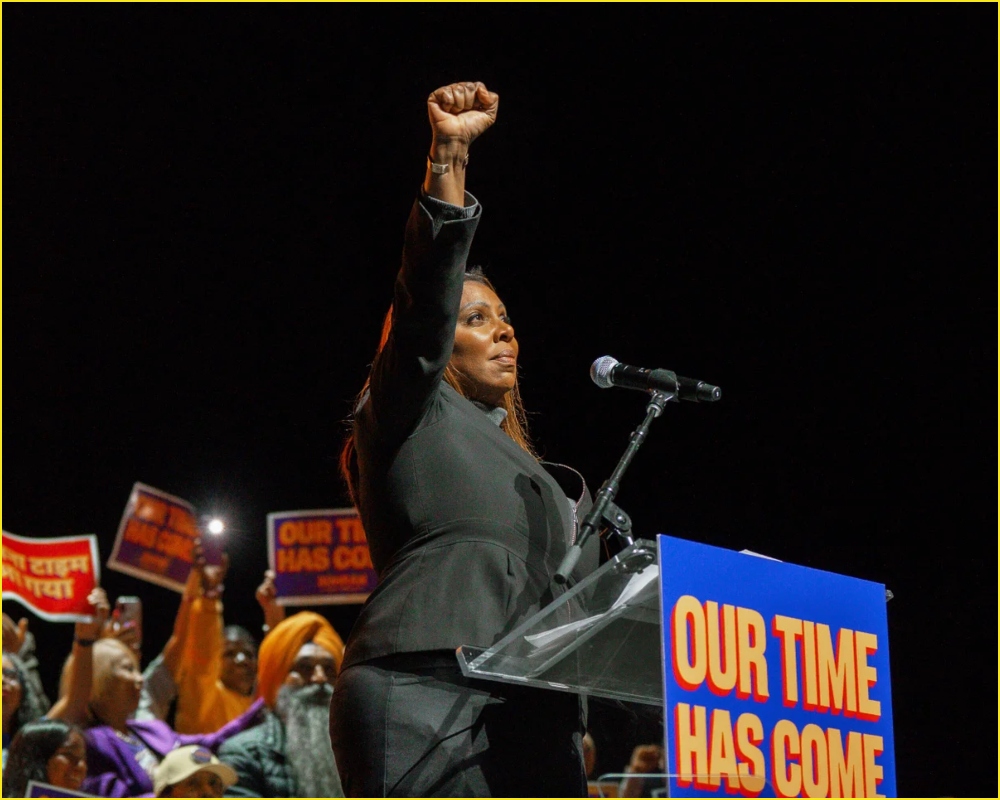
James: “I remain fearless”
Letitia James celebrated the dismissal in a statement that struck both relief and defiance.
“I am heartened by today’s victory and grateful for the prayers and support I have received from around the country,” she said. “I remain fearless in the face of these baseless charges as I continue fighting for New Yorkers every single day.”
Her longtime supporters echoed that sentiment, describing the case as a politically engineered prosecution designed to punish James for winning a civil fraud judgment against Trump — a decision later tossed by an appeals court for being “excessive,” but one that cemented her position as one of Trump’s chief legal adversaries.
A Prosecutor Installed Under Pressure
The case’s collapse stems from what the judge called a textbook abuse of executive power.
Halligan, a former Trump White House adviser, was pushed into the role of interim U.S. attorney last September after the prior interim prosecutor, Erik Siebert, was forced out. But her appointment came after the legally allowed 120-day window had expired — a deadline that required either Senate confirmation or court approval before a new interim prosecutor could take office.
Neither occurred.
Currie wrote that accepting the government’s defense of Halligan’s appointment “would allow the President and Attorney General to evade Senate confirmation indefinitely by stacking successive 120-day appointments,” adding bluntly: “That cannot be the law.”
Because Halligan was unlawfully installed, her grand jury actions — including the indictments of James and Comey — were void.
A DOJ in Chaos
The ruling triggered visible confusion inside the Justice Department.
Prosecutors in the Eastern District of Virginia were briefly instructed that the district’s first assistant, Robert McBride, would serve as acting U.S. attorney. Within an hour, that directive was reversed, and staff were told to continue listing Halligan — whose appointment had just been declared illegal — on filings.
Career attorneys privately described the moment as “chaotic” and “untenable,” unsure whether they had the legal authority to move ongoing cases forward.
The Deputy Attorney General’s office has reportedly been in constant communication with the Alexandria office to prevent further procedural missteps.
Political Shockwaves
The White House signaled an immediate appeal, with Press Secretary Karoline Leavitt saying the DOJ would challenge the ruling and “take all available legal action.”
Attorney General Pam Bondi, speaking at a press conference in Memphis, doubled down:
“We’ll be taking an immediate appeal to hold Letitia James and James Comey accountable for their unlawful conduct.”
Bondi also brushed aside Comey’s public criticism of the prosecution, saying, “I’m not worried about someone who has been charged with a very serious crime.”
Comey Calls the Case “Malevolence and Incompetence”
Comey, who was also cleared Monday, said the ruling was a reminder that presidents cannot weaponize the Justice Department against enemies.
“This prosecution was based on malevolence and incompetence,” he said in a video posted to Instagram.
“A president cannot use the Department of Justice to target his political enemies. That is fundamentally un-American.”
Comey predicted Trump “will probably come after me again,” adding: “I am not afraid.”
Trump’s Shadow Over the Case
Throughout their legal battles, both James and Comey have pointed repeatedly to Trump’s public calls for their prosecution. Trump posted in September that James, Comey, and Rep. Adam Schiff were “guilty as hell” and warned the Justice Department against “all talk, no action.”
Defense attorneys said the post demonstrated improper pressure — a point the judge did not rule on, but one that now hangs heavily over the DOJ’s handling of the case.
Legal Path Forward
The dismissal was “without prejudice,” meaning prosecutors could theoretically refile charges. But Currie appeared to acknowledge that the statute of limitations for Comey’s alleged conduct has likely expired.
For James, prosecutors could try again — though doing so would invite harsh scrutiny over political motivations, questions of prosecutorial legitimacy, and the perception that the case is tied to Trump’s personal grievances.
For now, James walks away vindicated. The DOJ walks away embarrassed. And a federal court has delivered one of the sharpest rebukes yet of the Trump administration’s attempts to use the justice system as a political weapon.