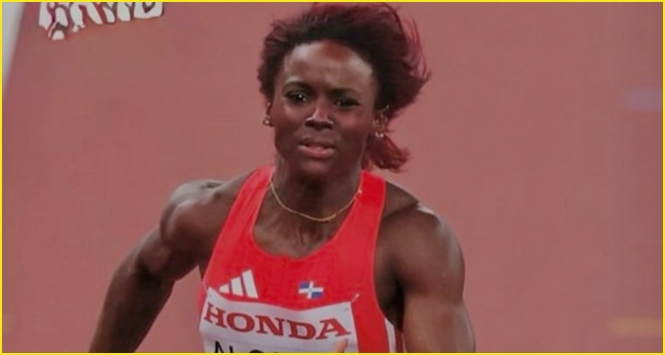
When 19-year-old Dominican sprinter Liranyi Alonso Tejada crossed the finish line in Tokyo, qualifying for the semifinals at the 2025 World Athletics Championships, she made history for her country. Yet, within hours of her victory, the celebration curdled into something far uglier.
Instead of being hailed as a national hero, Alonso found herself at the center of a racist firestorm — not from international critics, but from her own people.
Online trolls flooded her social media accounts with slurs, animalistic comparisons, and threats. Their message was chilling: she wasn’t “Dominican enough” to represent the nation.
The insults didn’t come from strangers abroad but from fellow Dominicans — a bitter irony for a young woman who had wrapped herself in her country’s flag just days earlier.
Her words, raw and restrained, landed like a national mirror.

A Victory Overshadowed by Hate
Born in Santo Domingo and raised in a working-class neighborhood in the capital, Alonso had already carved her place in Dominican sports history. She holds national records in the 60m and 100m, and her gold medal in the 200m at the 2025 Junior Pan American Games cemented her status as the country’s fastest woman.
In Japan, she stormed through the 100m heats to reach the semifinals — a rare feat for an athlete from the Caribbean nation. But as headlines abroad praised her performance, social media at home turned hostile.
Under posts celebrating her success, commenters mocked her skin tone, hair, and facial features. Some went so far as to question whether she was Haitian — a slur frequently weaponized in Dominican society, where anti-Haitian sentiment and colorism have deep historical roots.
By the time the Dominican Olympic Committee intervened, Alonso had received death threats serious enough to warrant police attention. She has since restricted her online profiles and begun trauma counseling.

A Mirror to Dominican Society
The controversy surrounding Alonso has reopened old wounds in the Dominican Republic — a country where racial identity remains a volatile subject.
Though most Dominicans are of mixed African and European descent, Blackness has long been stigmatized, often denied or minimized through euphemisms like “indio claro” (light Indian). The tension traces back to colonial history and the country’s complex relationship with neighboring Haiti.
Dr. Miguelina Estrella, a Dominican sociologist who studies race and culture, explained in a televised interview:
“Dominicans are taught to take pride in their flag but to distance themselves from their African roots. When someone like Liranyi steps into the global spotlight unapologetically Black, it forces the country to confront its own denial.”
That confrontation is now playing out in real time online. The hashtag #LiranyiEsDominicana (“Liranyi Is Dominican”) has surged across X (formerly Twitter), with over 50,000 posts as of Oct. 19. Many users, particularly younger Dominicans, are defending her against hate and demanding that the government address racial discrimination more directly.
Others, however, remain defensive — proof that this cultural reckoning is far from settled.

The Weight of Representation
For Alonso, the experience has been both painful and clarifying. Sources close to her team say she’s focusing on recovery and may defer competition until 2026.
Her story, however, has already transcended sport. It’s become a case study in how nations wrestle with their image when confronted by the realities of race.
The Dominican Republic is not alone in this struggle — but the backlash against Alonso, a young woman whose only “offense” was excelling while being Black, forces an uncomfortable truth to the surface: representation doesn’t end with visibility; it begins with acceptance.
Until that happens, athletes like Alonso will continue to bear the dual burden of performance and proof — running not just against the clock, but against prejudice itself.
The tragedy in Liranyi Alonso’s story isn’t that she faced racism — it’s that she faced it at home. Her ordeal reveals how deep colorism runs within communities that share the same flag and ancestry.
The Dominican Republic must decide whether its pride in diversity is symbolic or sincere. Until then, young athletes like Alonso will keep sprinting toward a finish line that, for now, still feels heartbreakingly uphill.