
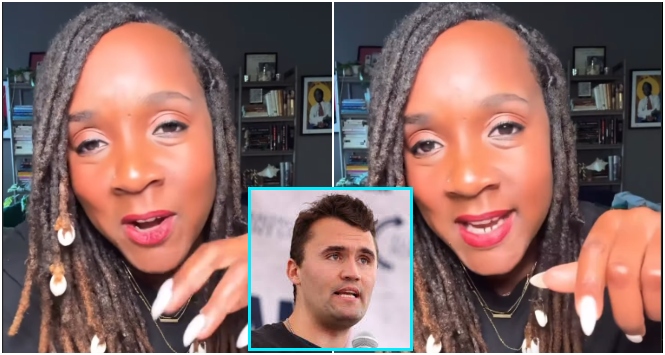
Danielle Moodie has posted a raw, unfiltered video reacting to the wave of firings and backlash targeting people deemed to be critcizing conservative commentator Charlie Kirk following his killing.
Known online as @deetwocents, the outspoken commentator’s Instagram video has ignited fresh debate about public outrage, free speech and moral responsibility.
In the now-viral Instagram clip, Moodie frames the moment as a national test of humanity. She argues the reaction to Kirk’s death exposes a deeply skewed set of public priorities — where some violent or dehumanizing rhetoric is tolerated while perfectly reasonable critiques of those views draw professional and social punishment.
“I truly feel like this moment in time and our lives in this country is really testing our humanity,” Moodie says in the video. “Do we want to live in a country that celebrates and mourns the death of a white nationalist? … We are in the upside down and it is up to all of us to get our heads on our shoulders.”
Key points from Moodie’s message
- Moral clarity over performative grief: Moodie rejects the idea that people must offer public condolences for someone whose rhetoric, she says, promoted violence and targeted marginalized groups. “You don’t have to mourn a white nationalist,” she says, adding this isn’t cruelty but discernment.
- Double standards in accountability: Moodie calls out perceived inconsistencies — for example, that inflammatory remarks from some media figures appear to draw fewer consequences than critical commentary from others. She warns that such double standards help normalize harmful speech.
- A political and cultural crossroads: Moodie frames the moment as an “eclipse” of sorts — a time when social masks fall away and the country must choose whether to acquiesce to fear, complacency, and dehumanization or to fight back through truth-telling and civic action.
- A call to action: She closes by urging viewers to “have our feet firmly planted” and to take responsibility at all levels — regardless of platform or income — to resist what she calls the creeping normalization of fascism.
Why the post matters now
The video comes during a period of heightened tensions after Kirk’s killing, when social-media reactions have prompted a wave of real-world consequences — from job suspensions to public condemnation — for people who spoke about the incident.
Following the assassination of Charlie Kirk last week, educators across the country have found themselves facing swift termination or potential discipline. They are alleged to have shared opinions deemed insensitive about Kirk’s murder on social media.
At least a dozen faculty and staff, from school board officials to classroom teachers, have been met with fallout over insensitive posts about Kirk’s death. In at least two instances, universities fired staff members entirely for posts deemed inappropriate.
Many other educators have been suspended or are under investigation, and the number is likely to grow as conservative online influencers share screenshots.
Ava Raine, the daughter of Dwayne “The Rock” Johnson, has also been criticized for sharing a post that admonished people to say nice things if they wanted to be celebrated if they pass away.
Moodie’s commentary also taps into an ongoing national debate about free speech vs. accountability, how society remembers public figures, and whether some speech should be considered so dangerous it forfeits public sympathy.
Her remarks also echo concerns voiced across communities and civil-rights groups: that language matters, that rhetoric can shape behavior, and that accountability (or the lack of it) signals what conduct will be normalized.
Public response and the broader conversation
Reactions to Moodie’s video have been mixed. Supporters praise her candor and see the clip as a necessary corrective to what they view as false equivalencies. Critics insist she’s contributing to a toxic information climate and that the moment requires greater restraint.
“✨THANK YOU!! For saying what needs to be said in this moment,The extreme gaslighting and profound cognitive dissonance is Just wearing me out. Thank you for confirming that I am not crazy and of a sound judgment.😊👌🏾✨,” one supporter commented.
Regardless of where someone stands on the issue, Moodie’s message has helped sharpen the conversation: when does critique become dehumanization, and when does public condemnation for hateful rhetoric cross the line into censorship or harassment?
What she wants readers to do
Moodie’s closing appeal is straightforward: think critically, act deliberately, and refuse to accept normalization of violent rhetoric.
“We all have a role in fighting fascism and it begins with telling and spreading the fucking truth,” she says.


