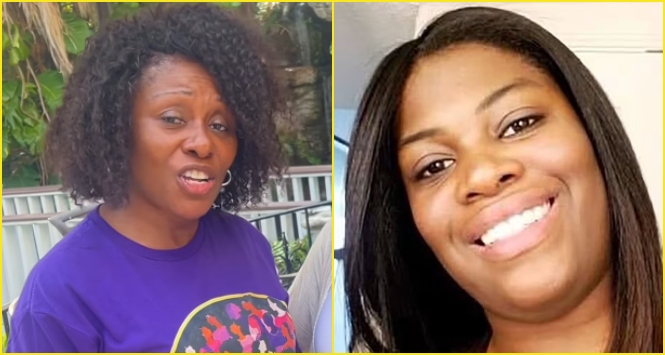
When Pamela Diaz appears on camera in the new Netflix documentary The Perfect Neighbor, her voice trembles, but her conviction is steady.
She recounts, in haunting detail, the moment her daughter, Ajike ‘A.J.’ Owens, was shot through a metal door in front of her nine-year-old son in Ocala, Florida.
The shooter, identified as Susan Lorincz, was charged with manslaughter with a firearm, culpable negligence, and assault after Owens’ death in 2023 — a case that reignited national conversations about race, gun violence, and the fraught legacy of “stand your ground” laws in America.
For Pamela, however, the tragedy is more than a headline or courtroom saga — it’s a daily struggle to hold her family together while navigating grief, displacement, and the unfinished business of justice.
“I relocated to Ocala to be with my grandkids,” Pamela says in an interview shared by actor and wellness advocate A.J. Akua Okyerebea Johnson (@theajzone). “I wasn’t prepared for this. We have housing issues. I’m unemployed because I have a four-year-old grandson who’s autistic and has multiple therapy appointments.”

A Crime That Shook a Nation
The killing of 35-year-old Ajike “A.J.” Owens, a devoted mother of four, by her white neighbor, unfolded in June 2023 and sent shockwaves through Florida and beyond.
According to reports, Owens had gone to Lorincz’s home to confront her about an ongoing dispute involving Owens’ children. Lorincz allegedly fired a gun through her closed door, striking Owens in the chest.
The case sparked widespread outrage after local activists accused authorities of delaying Lorincz’s arrest and minimizing the racial undertones of the encounter — Owens was Black, Lorincz is white. Prosecutors eventually charged Lorincz, who pleaded not guilty, claiming she acted in self-defense.
The Netflix documentary, produced by Soledad O’Brien and Takema Robinson, and directed by Geeta Gandbhir, unpacks not only the crime itself but the systemic cracks that allowed tensions, biases, and fear to escalate into tragedy.
The Documentary That Refuses to Look Away
The Perfect Neighbor — already nominated for six Critics Choice Awards and a Sundance winner — stands out for its unflinching honesty. It features never-before-seen body camera footage, raw interviews, and a close look at the aftermath of Owens’ death through Pamela’s eyes.
Okyerebea Johnson, who represents Pamela and publicly supports her, describes the project as both cathartic and necessary.
“It’s filled with trauma. It’s filled with anger,” she said in her Instagram post. “But turning our attention away from our reality turns our focus away from our steps forward. This is how we build real justice for A.J. and other victims.”
The film asks viewers to confront the “coddled culture” that often prioritizes comfort over accountability — a point Johnson says is central to understanding the Black American experience in moments of crisis.
Grief, Survival, and a Plea for Help
Pamela now raises her four grandchildren alone, including her autistic grandson who requires constant care. Her strength, she says, is born of necessity.
“You’re so busy with the kids,” she tells Johnson in the video, “your grieving process suffers.”
For Pamela, support is not abstract — it’s rent, childcare, therapy, and stability. A GoFundMe page, linked in Johnson’s bio, seeks to help the family find housing and sustain themselves while continuing the fight for justice.
Behind the statistics and the headlines is a grandmother who never expected to become both caregiver and advocate. The Perfect Neighbor ensures that A.J. Owens’ story — her humanity, her motherhood, her loss — is not lost to time or apathy
A Mirror Held to America
This documentary doesn’t just retell a crime, it holds a mirror up to the nation’s conscience. Owens’ killing exposes the deep and persistent tension between fear and prejudice, protection and violence, and the laws that claim neutrality but too often fail the vulnerable.
In an era where social justice fatigue looms, The Perfect Neighbor demands empathy, not complacency. It asks viewers not just to watch, but to witness — to sit in discomfort long enough to understand why this keeps happening.
As Johnson put it, “Push through your discomforts to grab the lessons we battle.”