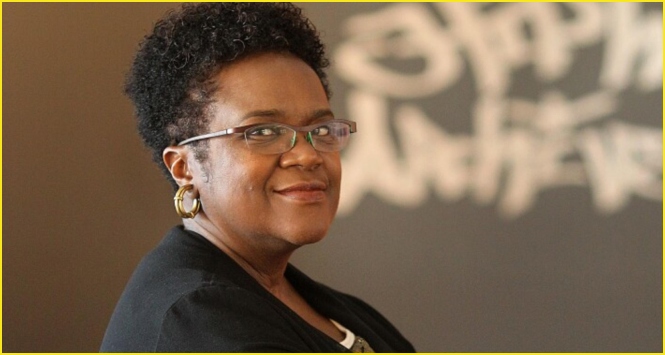
The academic world and the global hip-hop community are mourning the loss of Dr. Marcyliena H. Morgan, a pioneering linguistic anthropologist and the founding director of Harvard University’s Hip Hop Archive & Research Institute.
She died on Sept 28 at age 75 due to complications from Alzheimer’s disease.
Dr. Morgan’s life and work redefined the boundaries of cultural scholarship, challenging long-held academic biases about what constitutes serious study.
Through her vision, hip-hop—a genre once dismissed as street noise—became recognized as a complex cultural, linguistic, and artistic force worthy of rigorous intellectual engagement.

A Scholar Who Saw What the Academy Overlooked
Before she was the matriarch of hip-hop scholarship, Dr. Morgan was a professor at UCLA, teaching a course on urban speech communities in the early 1990s. It was there, she said, that her students changed her perspective forever.
“There was a class of 300 people and there were 80 papers on hip-hop,” Morgan recalled in a 2003 interview. “I said, ‘No, no, no, this isn’t a course about fun.’ But they said, ‘You don’t understand, this is about real things, this is about life.’”
That moment of confrontation between academic theory and lived reality became a turning point. Initially skeptical of hip-hop’s lyrical content, particularly its misogyny, Morgan began to look deeper. What she found was linguistic genius—an entire generation of young Black artists using rhythm, rhyme, and narrative to reflect the complexity of Black life in America.
“Hip-hop has been pulling me this weird way all along,” she said in 2013. “I thought, ‘This is material culture, so let’s study it.’”
From Idea to Institution: Building the Hip Hop Archive
In 1996, Morgan brought her idea to Dr. Henry Louis Gates Jr., one of the nation’s most prominent scholars of African American literature and culture. Initially unsure, Gates said he was quickly persuaded by her conviction that hip-hop was not a passing trend but a global cultural language.
“‘This music,’ she said looking at me like I was an idiot, ‘was our youth vernacular language manifesting itself in a completely new form of music,’” Gates recalled earlier this year. “She insisted it was the lingua franca of American popular culture—and here to stay.”
Her persistence paid off. In 2002, Morgan launched The Hip Hop Archive & Research Institute (HARI) at Harvard University—the first and most comprehensive repository of hip-hop’s cultural history. The archive collected not just albums and lyrics, but essays, videos, interviews, and ephemera documenting the music’s social and political power.
Her efforts sparked similar projects at Cornell University, UMass Boston, Georgia State, and the College of William & Mary, cementing hip-hop’s place within academia.
Hip-Hop Meets Harvard: The “Classic Crates”
Among the Archive’s most celebrated achievements is the Classic Crates collection—a curated anthology of landmark hip-hop albums housed in Harvard’s Eda Kuhn Loeb Music Library alongside classical giants like Mozart and Beethoven.
Each record—annotated with Morgan’s scholarly liner notes—was analyzed as a work of composition, cultural commentary, and linguistic innovation. The inaugural selections included:
- Illmatic by Nas
- The Low End Theory by A Tribe Called Quest
- The Miseducation of Lauryn Hill by Lauryn Hill
- To Pimp a Butterfly by Kendrick Lamar
Curated in partnership with producer 9th Wonder, the series seeks to preserve 200 defining hip-hop albums for future generations.
Morgan’s framing of these works as “classical” compositions—each with form, rhythm, and poetic depth—helped reposition hip-hop within both the scholarly and cultural canon.
A Legacy Beyond the Archive
Earlier this year, Dr. Hopi Hoekstra, Dean of the Faculty of Arts & Sciences at Harvard, announced that the archive would be renamed in Morgan’s honor, a gesture recognizing her extraordinary contributions to both academia and culture.
It’s a fitting tribute for a woman who, over two decades, bridged the gap between the Ivy League and the inner city—between what the academy once dismissed and what millions lived daily.
Dr. Morgan’s death leaves a void not only in scholarship but in the broader narrative of Black cultural preservation. She gave voice—and institutional legitimacy—to a generation of artists, activists, and thinkers whose work was often undervalued or misunderstood.
Her vision reframed hip-hop not just as music, but as a movement of language, politics, and identity—a reflection of the struggle, resilience, and brilliance of Black America.
As her mentor Henry Louis Gates Jr. said at a recent symposium:
“Marcyliena didn’t just archive hip-hop. She validated it. She gave it the respect the academy had denied—and in doing so, she changed how we understand culture itself.”