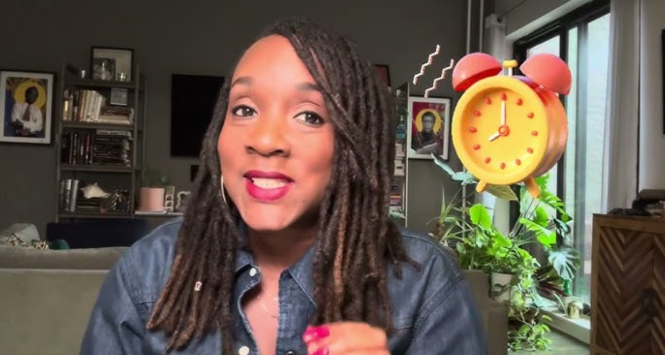
An activist’s fiery plea for a mass nationwide work stoppage over the Trump administration’s policies is gaining traction online.
Danielle Moodie, a prominent critic of President Donald Trump who has mobilized followers online under the handle @deetwocents, urged supporters this week to plan a coordinated “national strike” during the U.S. holiday season — a move she said would “black out” consumer spending and force political change.
“We need a #nationalstrike NOW!” Moodie wrote on Instagram and in an accompanying video argued that the period between Thanksgiving and Christmas would be the ideal pressure point.
“Donald Trump is weak right now and we need to capitalize on it,” she said, calling for a rolling shutdown of transit, retail and public services, followed by teacher and school staff walkouts in January.
Her plea, not the first time, is the latest escalation in an intensifying array of digital-era protest strategies that aim to harness economic leverage and viral attention. But it also raises immediate legal and practical questions, and ethical concerns about the potential harms of a mass strike that interrupts services relied on by millions.

What Moodie is asking for
Moodie’s plan, as laid out in the video, called first for transportation workers — including air traffic controllers, bus and subway operators, and rideshare drivers — to participate in an initial stoppage, then for national retail and service-sector workers to refuse holiday shifts and for educators to strike when schools reopen.
The stated goal: to “shut the country down” until political power shifts and policy decisions are reversed.
She framed the action as tactical, rooted in the belief that collective economic nonparticipation during the busiest retail window would focus national attention and pressure elected officials. Moodie credited Chicago Mayor Brandon Johnson for publicly endorsing the idea and urged other officials to follow.
Legal and practical obstacles
Labor law and public-safety considerations present immediate hurdles to a movement of the kind Moodie described. Federal employees — including many air traffic controllers and certain public-safety personnel — face statutory restrictions on strikes. The Taft–Hartley Act and related federal statutes bar many categories of government employees from engaging in work stoppages and provide tools for employers and the federal government to seek injunctions and penalties.
Air traffic controllers, specifically, are governed by the Federal Aviation Act and historically have been prohibited from striking; the Professional Air Traffic Controllers Organization (PATCO) strike in 1981 remains a landmark example of the severe penalties federal authorities can impose.
Refusal to work by safety-critical personnel also raises immediate risks to public welfare and could expose participants and organizers to criminal or civil consequences.
Private-sector strikes, meanwhile, involve a different calculus. Under U.S. labor law, many private-sector employees have the right to strike under the National Labor Relations Act (NLRA), but those rights are exercised through organized union action, with legal safeguards and negotiation protocols.
A decentralized, social-media-driven “national strike” that depends on ad hoc participation from non-unionized workers and gig-economy contractors creates both logistical challenges and legal ambiguity. Rideshare drivers, for instance, are classified as independent contractors in many jurisdictions, and companies can respond with deactivation or other penalties.
Ethical and political trade-offs
Beyond legality, civil-society experts warn a blackout-style strategy risks alienating the very constituencies protest organizers seek to mobilize.
There is also the question of whether the tactic is politically effective. Mass civil disobedience has succeeded in forcing policy change in certain historical contexts, but analysts say the contemporary media environment and deep partisan polarization make predictable outcomes less certain.
Responses from labor and law enforcement
Labor leaders and unions have been cautious. The AFL–CIO told reporters it supports “legitimate, organized worker-led actions,” but stressed that “calls for spontaneous, citywide shutdowns without worker input risk endangering livelihoods and safety.”
Several municipal unions, including transit and teachers’ unions, said they had not been contacted by Moodie or her team and emphasized that any job action would require internal democratic votes, legal analysis and contingency planning.
Federal and local officials reiterated that safety-critical employees face legal constraints.
“We will not tolerate actions that jeopardize public safety,” said a Department of Transportation spokesperson, adding that federal labor regulations and statutes would guide responses.
Political fallout and next steps
Politically, the call for a national strike exposes divisions within the broader opposition movement. Some progressive organizers praised Moodie’s urgency, noting that the U.S. holiday economy wields enormous leverage. Others criticized the tactic as impractical or harmful to non-political constituencies.
Conservative commentators and many Republican officials denounced the idea as “reckless” and vowed to characterize such efforts as attempts to disrupt ordinary Americans’ lives.
Legal experts note that, outside of safety-critical roles, a well-organized and legally sanctioned strike could be a legitimate tool of political pressure. But a movement that relies on mass social-media appeals without union infrastructure or legal counsel is likely to face both enforcement actions and diminishing public support if critical services are disrupted.
Human dimension and motivation
Moodie’s plea comes from a place of political urgency. In her video she described her view that democratic norms are under threat and argued that dramatic action is necessary to defend them. That urgency resonates with many Americans who feel disillusioned with traditional political channels.
But opponents say dramatic gestures must be balanced against civic responsibility. “Politics doesn’t exist in a vacuum — people’s lives do,” said community organizer Tamika Lewis. “We must weigh moral clarity against tactical prudence.”
Bottom line
Calls for a mass “national strike” during the holiday season crystallize a key tension in modern activism: the thirst for immediate leverage against perceived threats to democracy, and the complex legal, ethical and practical realities of mounting disruptive actions in a hyperconnected society.
If Moodie’s campaign gain traction the coming weeks will likely see intensified legal scrutiny, union responses and political messaging.
Organizers and participants who consider civil disobedience would be well-advised to consult legal counsel, coordinate with worker representatives and plan safeguards for vulnerable communities that could bear the brunt of a stoppage.