
Georgia State Rep. Jasmine Clark is on the verge of making history after securing the Democratic nomination for Georgia’s 13th Congressional District, positioning her to become the first Black woman with a science Ph.D. elected to the U.S. Congress.
For Clark, a microbiologist, professor, and longtime science educator, the campaign is about more than politics. It is about bringing scientific expertise into government at a time when public health, misinformation, and science policy have become increasingly central to national debates.
“We need science voices at every single level of government,” Clark said in a recent interview with Chemical & Engineering News. “There are lots of different ways to get involved in politics without necessarily running for office.”
Clark, 43, won the Democratic primary with approximately 56% of the vote following the death of longtime Democratic Congressman David Scott, whose passing unexpectedly opened the seat just weeks before the election. She is now set to face Republican candidate Jonathan Chavez in November in a district that has historically favored Democrats.
If elected, Clark would break new ground in a Congress that has long been criticized for lacking representation from scientific and technical professions.
From Microbiology Lab to Political Leadership
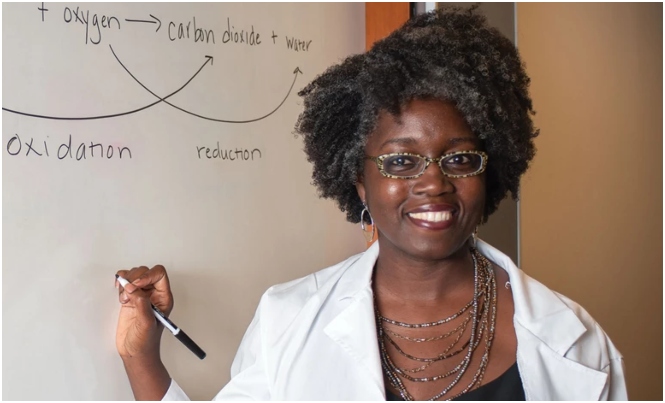
Clark’s path to politics was anything but conventional.
Born in Atlanta, she initially planned to follow her parents into medicine. Her father is a physician and her mother a nurse. While studying at the University of Tennessee, however, she discovered a passion for scientific research and eventually earned a doctorate in microbiology from Emory University.
Her doctoral research focused on retroviruses similar to HIV, using advanced imaging techniques to study how viruses move and behave inside living cells. After completing postdoctoral research on HIV transmission, Clark transitioned into education, spending years teaching science and mentoring students.
Politics was never part of the plan.
“If you had asked me when I first went to graduate school if I would get into politics, the answer would have been absolutely not,” Clark said.
She traces her political awakening to the 2016 presidential election:
“Donald Trump got elected on a night in November of 2016. I went to sleep a scientist, and I woke up the next morning a mad scientist.”
That frustration led her to organize Atlanta’s 2017 March for Science, where thousands gathered to advocate for evidence-based policymaking and scientific research.
Bringing Scientific Thinking to Government
Clark says her scientific training has fundamentally shaped how she approaches public service.
Rather than accepting information at face value, she applies the same analytical methods she learned as a researcher.
“I ask a lot of questions because I want to understand,” she said.
During her tenure in the Georgia House of Representatives, Clark said that approach helped her uncover questionable claims in proposed legislation, including instances where cited sources could not be verified.
Her expertise became especially valuable during the COVID-19 pandemic, when lawmakers and constituents sought guidance from someone with a background in virology and viral transmission.
Clark argues that Congress needs more members capable of challenging misinformation with subject-matter expertise.
“I’m seeing a lot of misinformation that is not being challenged in a way that I think it should be challenged,” she said. “We need someone in Congress that knows how to push back against this.”
Her experience as a professor has also shaped her ability to communicate complex issues.
“I’ve had so many colleagues say to me, ‘You have a knack for explaining difficult concepts and making them plain for people,’” Clark noted.
Science, Policy and Representation
Clark’s candidacy comes amid growing concern within the scientific community about the relationship between research and public policy.
She argues that scientists can no longer afford to view themselves as separate from politics because government decisions directly influence research funding, public health priorities, and scientific advancement.
“Policy and politics play a big role in science,” Clark said. “Grant funding is very political.”
Her campaign has emphasized health care, education, public health, and evidence-based policymaking, themes that resonate with voters who increasingly see scientific literacy as a valuable asset in elected leaders.
Many constituents, Clark said, connect her scientific credentials to issues that affect their daily lives—from disease prevention to college opportunities and medical care.
“A lot of people say we just need smart people in Congress,” she said.
A Historic Opportunity
Should she prevail in November, Clark would enter Congress as a historic first.
“It is a big role to fill, because whenever you’re first, you set the bar,” she acknowledged.
Yet she also sees the milestone as long overdue.
“I am absolutely elated for this opportunity to be the first Black woman with a science Ph.D. to ever serve in Congress,” Clark said. “I think it is needed. I think it is way past due.”
As the United States approaches its 250th anniversary, Clark argues that the absence of Black women scientists in Congress highlights a broader need for greater diversity of expertise in government.
“We haven’t had this voice in the room yet,” she said. “What are we waiting for? Let’s get this done.”
Her candidacy is increasingly being viewed not only as a political campaign but also as a test of whether voters are ready to elevate scientific expertise, and a new generation of Black women leaders—to the highest levels of national policymaking.

